
Meta: Curious how ultrasonic cleaning removes contaminants from industrial parts? Learn the science behind cavitation, frequency selection, system components, and which applications benefit most from ultrasonic technology.
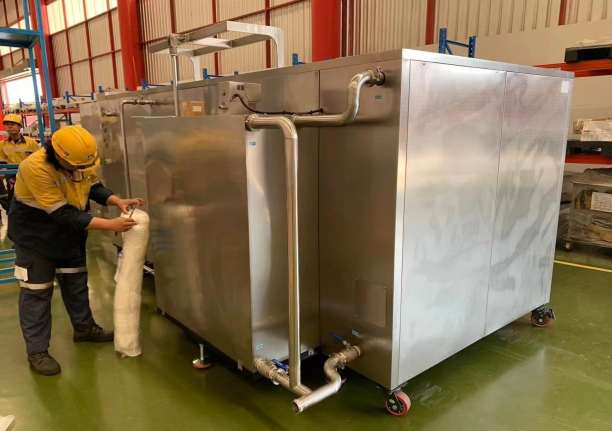
How Do Industrial Ultrasonic Cleaners Work? Principles & Applications Explained
Industrial ultrasonic cleaners are widely used across manufacturing, remanufacturing, and precision assembly — but many engineers who specify or operate them don’t fully understand the underlying physics. This article explains how ultrasonic cleaning works at the component level, what frequencies mean, and which industrial applications deliver the greatest return on investment.
The Core Principle: Acoustic Cavitation
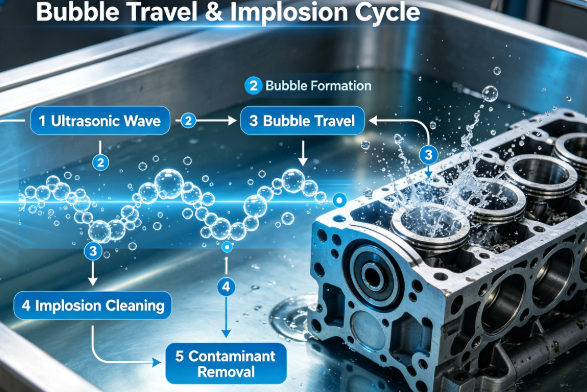
At its simplest, an ultrasonic cleaning system converts electrical energy into high-frequency sound waves that travel through a liquid cleaning solution. The physical effect that does the actual cleaning is called cavitation.
What Happens During Cavitation?
1. Ultrasonic transducers bonded to the tank bottom or sides vibrate at frequencies above human hearing (typically 20–120 kHz)
2. These vibrations create alternating high-pressure and low-pressure waves in the liquid
3. During low-pressure phases, microscopic vacuum bubbles form in the liquid
4. During high-pressure phases, these bubbles collapse (implode) almost instantly
5. Each collapse generates a localized micro-jet of liquid moving at extremely high velocity
Thousands of these implosions happen every second across every submerged surface. The cumulative scrubbing effect dislodges contaminants — oil, grease, carbon, particulate, flux residue — without abrasion or mechanical force.
Key System Components
1. Ultrasonic Transducers
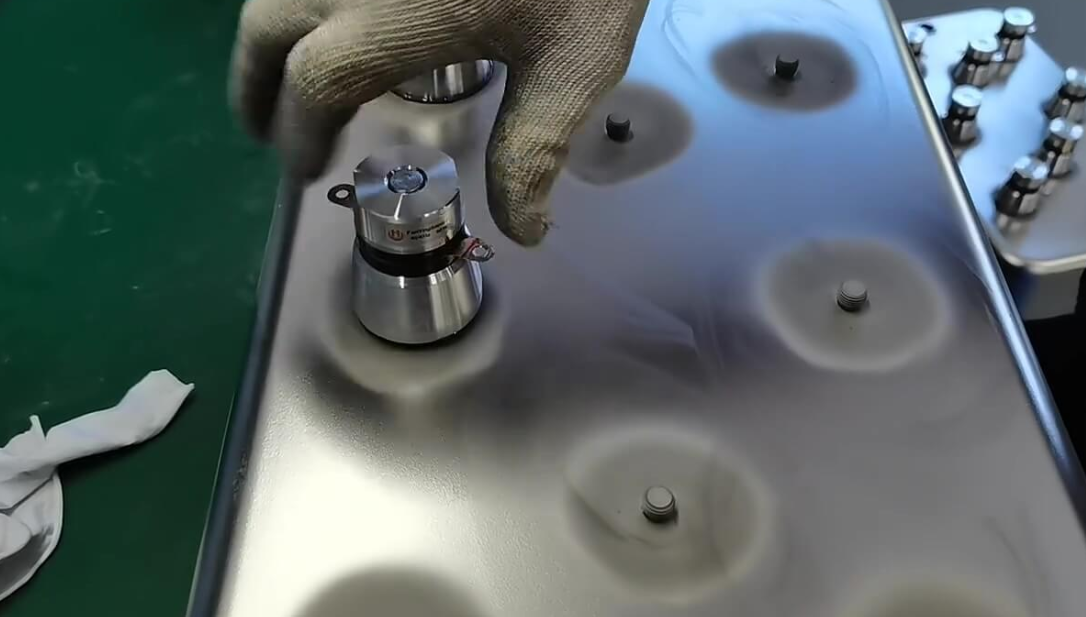
Transducers are the devices that convert electrical energy into mechanical vibration. Most industrial systems use piezoelectric transducers made from ceramic materials (typically lead zirconate titanate, or PZT).
- • Mounted externally to the tank bottom or side walls
- • Welded or epoxied in place (welded mounting is more durable for industrial use)
- • Quantity and placement determine ultrasonic power density (W/L)
2. Ultrasonic Generator
The generator (also called the power supply) converts standard line voltage into the high-frequency AC signal that drives the transducers.
Industrial-grade generator features: – Sweep frequency function — prevents standing waves and “dead zones” in the tank – Adjustable power output — for delicate vs. heavy-soil applications – Overheat and over-current protection – Digital timer and temperature controls – PLC integration capability for automated lines
3. Cleaning Tank
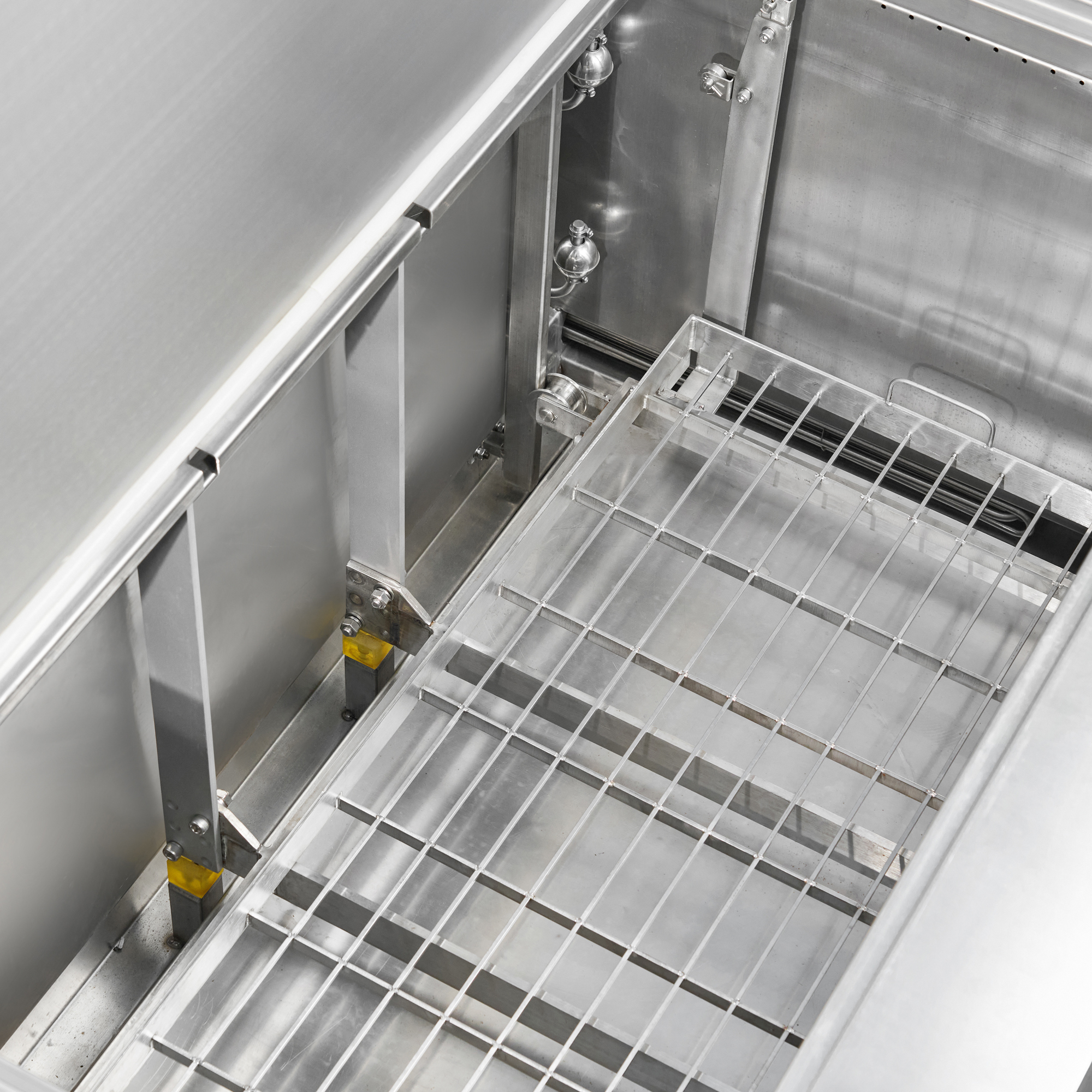
The tank holds the cleaning solution and must withstand continuous cavitation and chemical exposure.
- • 304 stainless steel for general aqueous cleaning
- • 316L stainless steel for corrosive chemistries and long service life
- • Fully welded and polished interior seams
- • Insulated exterior for energy efficiency and operator safety
- • Drain, overflow, and filtration ports
4. Heating System
Most industrial applications require heated solution for optimal cleaning. Immersion electric heaters are standard, sized to maintain 50–80°C depending on the detergent.
5. Filtration & Oil Removal
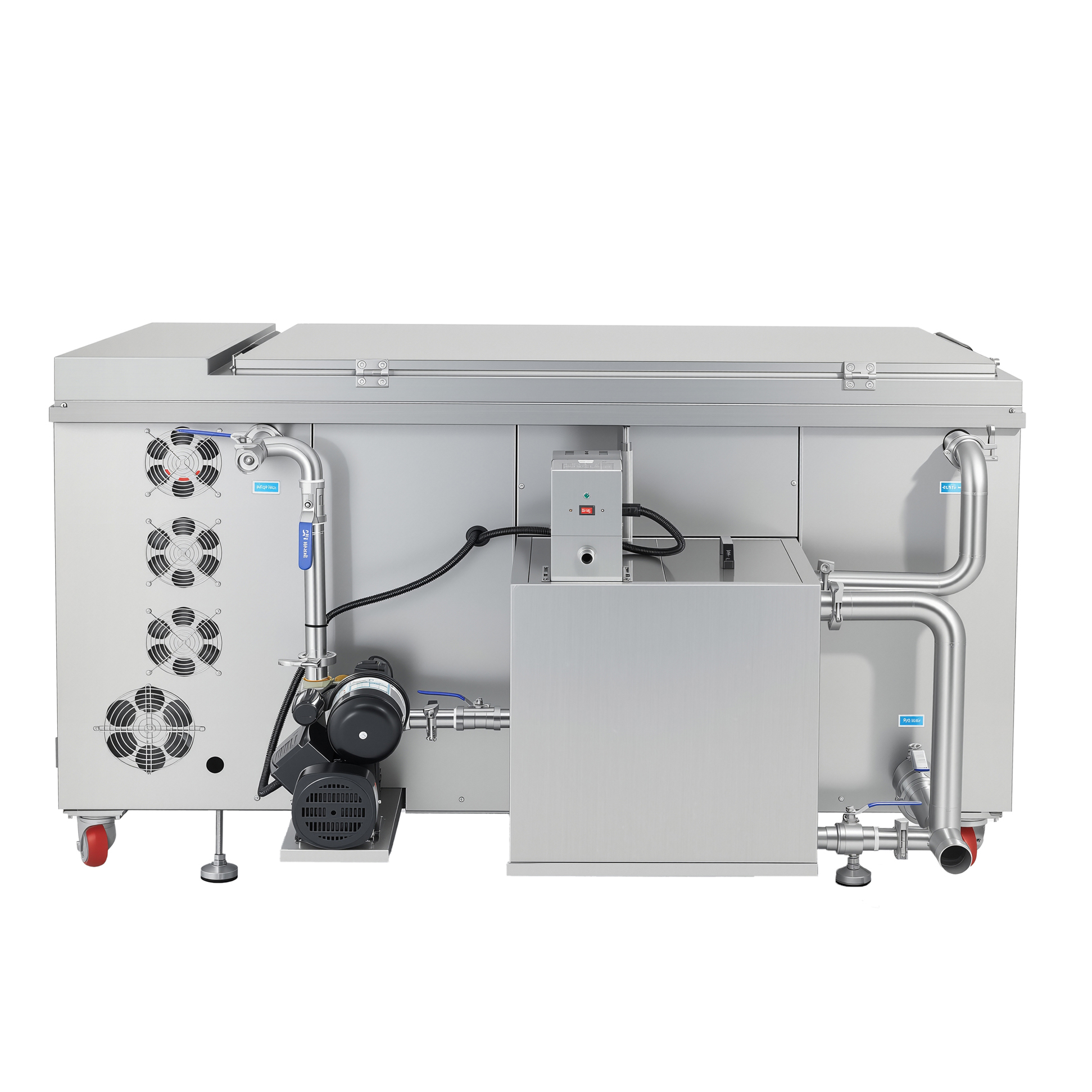
Industrial systems include: – Particulate filtration (5–50 micron) to remove suspended solids – Oil skimmer or coalescer to separate floating grease and oil – These extend bath life and prevent redeposition of removed contaminants
Understanding Frequency Selection
Frequency is one of the most important — and most misunderstood — parameters in ultrasonic cleaning.
| Frequency Range | Cavitation Intensity | Bubble Size | Best For |
| 20–28 kHz | High energy, aggressive | Larger bubbles | Heavy grease, carbon, rust scale — robust parts |
| 40 kHz | Balanced, general-purpose | Medium | Most industrial parts, general degreasing |
| 68–80 kHz | Gentle, high-density | Smaller bubbles | Precision parts, delicate features, electronics |
| 100–130 kHz | Very gentle, ultra-fine | Microscopic | Semiconductor, medical, optical components |
Rule of thumb: Lower frequency = more aggressive cleaning, larger parts, heavier soils. Higher frequency = gentler cleaning, finer details, more delicate surfaces.
Browse standard and custom industrial ultrasonic systems across all frequency ranges from Tense.
Primary Industrial Applications
Automotive & Engine Manufacturing
Degreasing of machined engine components, transmission parts, brake calipers, and fuel injectors. Critical for proper assembly function and paint adhesion.
Remanufacturing & Rebuild
Removal of carbon, varnish, and heavy grease from engine blocks, cylinder heads, gearboxes, and turbochargers — essential before inspection and reassembly.
Aerospace & Defense
Precision cleaning of turbine blades, hydraulic manifolds, and structural components to exacting cleanliness standards. Often validated with particle counting or white light inspection.
Medical Device Manufacturing
Removal of polishing compound, machining oils, and bio-burden from surgical instruments and implant components. Validated cleaning processes are required for regulatory compliance.
Electronics & Semiconductor
Removal of flux residue, solder balls, and particulate from PCB assemblies, connectors, and semiconductor packaging.
Metal Finishing & Plating
Pre-plating cleaning that ensures proper adhesion of electroplated coatings. Poor pre-cleaning is the #1 cause of plating defects.
What Ultrasonic Cleaning Cannot Do
While versatile, ultrasonic cleaning has limits: – It does not remove heavy rust scale or thick paint (these require acid pretreatment or media blasting) – It will not polish or improve surface finish (it cleans existing surfaces without abrasion) – Extremely blind holes with aspect ratios beyond ~15:1 may have reduced effectiveness at the bottom – Porous materials (sintered metal, castings with high porosity) can trap solution and require extended drying
Conclusion
Industrial ultrasonic cleaning works through controlled cavitation — millions of microscopic bubble implosions that scrub contaminants from every accessible surface. The technology excels at applications requiring consistent, repeatable, labor-efficient cleaning of parts with complex geometry. Understanding frequency selection and system components helps engineers specify the right equipment for each application.
For application-specific recommendations and process validation, contact the engineering team at Tense.
Frequently Asked Questions
Q: Does ultrasonic cleaning damage parts? A: When properly configured for the part material and soil load, ultrasonic cleaning is non-damaging. Problems occur only when using incorrect frequency, excessive power, or incompatible chemistry on sensitive materials.
Q: How long does an ultrasonic cleaning cycle take? A: Typical industrial cycles range from 3–20 minutes. Light degreasing of freshly machined parts takes 3–5 minutes. Heavy carbon removal from engine components takes 15–30 minutes.
Q: What temperature should the ultrasonic bath be? A: Most water-based detergents work optimally between 50–65°C. Higher temperatures increase chemical activity but reduce cavitation intensity (hotter water holds less dissolved gas). The sweet spot for most industrial applications is 55–60°C.
Q: Can ultrasonic cleaning replace solvent degreasing? A: Yes, in most applications. Modern aqueous ultrasonic systems with proper detergent formulation achieve the same or better cleanliness than solvent degreasers, without the VOC emissions, fire risk, and regulatory burden of solvent-based systems.
Post time: Jul-20-2026