
How Ultrasonic Cavitation Actually Cleans Metal Parts: A Simple Guide
Introduction
If you have spent any time researching industrial cleaning methods, you have probably come across the term ultrasonic cleaning more than once. You may have read that it uses sound waves to clean parts, or that it creates microscopic bubbles. But how does it actually work? How can something as intangible as sound waves remove stubborn grease, carbon, and dirt from metal parts? In this straightforward guide, we break down the science of ultrasonic cavitation in plain language, explain how it cleans metal parts at the microscopic level, and help you understand why an ultrasonic cleaning machine is often the most effective choice for industrial parts cleaning.
What Is Ultrasonic Cavitation?
The Basics: Sound Waves Beyond Human Hearing
Ultrasonic cleaning starts with sound waves—specifically, sound waves at frequencies above the range of human hearing. While humans can typically hear sounds up to about 20 kHz (20,000 cycles per second), ultrasonic cleaners operate at frequencies ranging from 20 kHz to over 100 kHz.
These high-frequency sound waves are generated by electronic oscillators and converted into mechanical vibrations by transducers bonded to the cleaning tank. The transducers vibrate the tank wall at the ultrasonic frequency, which in turn sends pressure waves through the cleaning solution inside the tank.
The Birth of a Bubble: How Cavitation Forms
Here is where the magic happens. As the ultrasonic pressure waves travel through the liquid, they create alternating regions of high and low pressure. During the low-pressure half of the cycle, the pressure drops so low that the liquid literally boils at room temperature, forming tiny vapor-filled bubbles. This process is called cavitation—the formation of cavities (bubbles) in a liquid.
These bubbles are incredibly small—typically only a few microns in diameter, far too small to see with the naked eye. They form in the low-pressure troughs of the sound waves and exist for only a fraction of a second.
The Power of Implosion
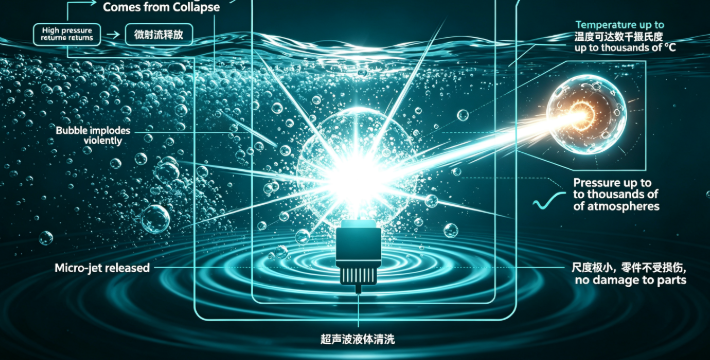
The real cleaning power comes not from the formation of the bubbles, but from their collapse. When the pressure wave swings back to high pressure, the bubbles implode—violently and almost instantaneously.
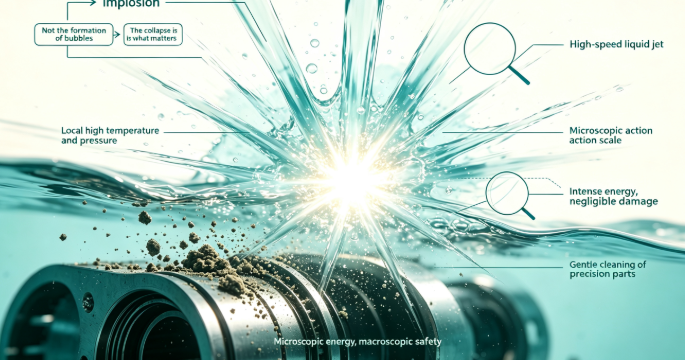
Each imploding bubble releases a tiny but extremely powerful jet of liquid that shoots outward at speeds of hundreds of miles per hour. The temperature inside the collapsing bubble can reach thousands of degrees Celsius, and the pressure can exceed thousands of atmospheres.
Now, you might be wondering: if the temperatures and pressures are so extreme, why does not it damage the parts being cleaned? The answer is scale. Each bubble is so small that its energy, while intense at the microscopic level, is negligible at the scale of a metal part. It is like comparing a single grain of sand to a beach—powerful in microcosm, but gentle in aggregate.
How Cavitation Cleans Metal Surfaces
The Scrubbing Action of Billions of Bubbles
A typical industrial ultrasonic cleaner generates billions of cavitation bubbles every second throughout the cleaning tank. Each bubble implodes with a tiny burst of energy, creating a micro-scrubbing action on any surface it touches.
When you have billions of these bubbles imploding simultaneously, the cumulative effect is a thorough and uniform cleaning action that reaches every surface exposed to the cleaning solution. It is like having billions of microscopic scrub brushes working at once, reaching into every crevice, every hole, every crack, and every surface irregularity.
This is the fundamental advantage of ultrasonic cleaning: it does not rely on direct mechanical contact or directed spray. It cleans every surface the solution touches, regardless of orientation or geometry.
Penetrating Blind Holes and Internal Passages
One of the most impressive features of cavitation cleaning is its ability to clean inside blind holes, internal passages, and other hard-to-reach features.
Here is why it works: the cleaning solution flows into every cavity and passage, driven by simple fluid dynamics. Wherever the solution goes, the ultrasonic energy goes with it. And wherever the ultrasonic energy goes, cavitation occurs—even deep inside a narrow hole or a complex internal passage.
For a part like a cylinder head with dozens of cross-drilled oil passages, this is a game-changer. Traditional cleaning methods struggle to reach the middle of these passages, but ultrasonic cavitation cleans them from end to end.
Lifting Contaminants from the Surface
So how exactly does cavitation remove dirt, grease, and carbon from a metal surface? The mechanism is a combination of physical and chemical effects:
Physical action: The micro-jets from imploding bubbles bombard the contaminant layer, breaking it apart and dislodging it from the surface. This mechanical action works like microscopic scrubbing, but without the abrasion of a brush.
Chemical enhancement: Cavitation also enhances the effectiveness of the cleaning detergent. The extreme conditions at the bubble interface accelerate chemical reactions between the detergent and the soil, helping to break down grease and oil more quickly. This is why ultrasonic cleaning works so well even with mild detergent concentrations.
Penetration: The pressure waves from cavitation can penetrate porous contaminant layers, working their way down to the substrate surface and lifting the soil from below. This is particularly effective for removing carbon deposits and other tenacious contaminants.
Factors That Affect Cavitation Performance
Frequency: Size Matters
The frequency of the ultrasonic waves has a direct effect on the size and intensity of the cavitation bubbles:
Lower frequencies (20–28 kHz) produce larger, more energetic bubbles that implode with greater force. This makes them ideal for heavy-duty cleaning applications where you need to remove thick, stubborn deposits like carbon or heavy grease.
Higher frequencies (40–80 kHz) produce smaller, gentler bubbles that are less aggressive but more numerous. They are better for cleaning delicate surfaces, precision parts, or applications where surface finish is critical.
Very high frequencies (100+ kHz) produce extremely small bubbles that provide very gentle cleaning, suitable for highly delicate components like electronics or medical devices.
Choosing the right frequency is one of the most important decisions when selecting an ultrasonic cleaning machine for your application.
Power: More Is Not Always Better
Ultrasonic power—measured in watts—determines how much energy is being put into the cleaning solution. Generally, more power means more cavitation and faster cleaning. But there is a point of diminishing returns, and too much power can actually be counterproductive.
When the power density is too high, the cavitation bubbles become so dense that they form a “cloud” near the transducer surface. This cloud actually blocks the ultrasonic energy from penetrating deeper into the tank, reducing cleaning effectiveness in the bulk of the solution.
The optimal power density depends on the tank size, frequency, and application. A well-designed industrial ultrasonic cleaner will have the right balance of power and tank volume for consistent, effective cleaning throughout.
Temperature: The Heat Factor
Temperature plays a crucial role in ultrasonic cleaning performance. Most cleaning solutions work better at elevated temperatures, and heat also affects cavitation:
Higher temperatures reduce the surface tension of the liquid, making it easier for cavitation bubbles to form
Warmer solutions enhance the chemical action of detergents
Heat softens grease and oil, making them easier to remove
However, there is an optimal temperature range for cavitation—typically between 50°C and 70°C for most water-based solutions. Above about 80°C, the vapor pressure inside the bubbles becomes so high that the implosions are less violent, reducing cleaning effectiveness.
Detergent: The Chemical Partner
While cavitation provides the mechanical energy, the cleaning detergent provides the chemical action that breaks down specific types of soil. The right detergent:
Lowers surface tension to improve cavitation formation
Breaks the chemical bonds between soil and substrate
Emulsifies oils and greases
Prevents redeposition of removed contaminants
Using the right detergent at the right concentration is essential for getting the best performance from your ultrasonic cleaning system.
Common Misconceptions About Ultrasonic Cleaning
Myth: Ultrasonic Cleaning Is Just “Vibrating the Dirt Off”
While it is true that ultrasonic cleaning uses vibrations, that is an oversimplification. The cleaning action comes not from the vibration itself, but from the cavitation bubbles generated by the vibrations. The vibration is the cause; cavitation is the effect that does the actual cleaning.
Myth: Ultrasonic Cleaning Damages All Parts
This is a common concern, but it is not accurate. When properly configured with the right frequency, power, and detergent, ultrasonic cleaning is safe for most metal parts and many non-metal parts. The key is matching the parameters to the application. A 25 kHz system may be too aggressive for delicate electronics, but it is perfectly safe for heavy steel components.
Myth: All Ultrasonic Cleaners Are the Same
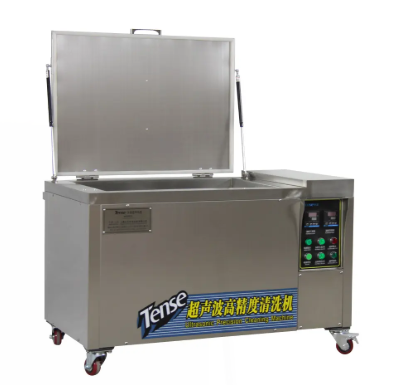
Ultrasonic cleaner TS series
Short Description:
TS series has been specifically designed for the cleaning and degreasing of all type of parts and components in Automotive industry. It achieves excellent cleaning results in many types of materials, especially in complex parts, where the ultrasounds have excellent results thanks to its high penetration capacity. Thus, the results while cleaning automobile engines are spectacular, even in those smaller and delicate parts.
Our Automotive series uses 28 kHz frequency with which the best results for the Automotive Sector are achieved.
There is enormous variation in quality and performance among ultrasonic cleaners. Cheap units may have inadequate transducer placement, poor generator design, or insufficient power that results in uneven cleaning or short equipment life. A quality industrial ultrasonic cleaner from a reputable manufacturer will be engineered for uniform cavitation, reliable operation, and long service life.
Conclusion
Ultrasonic cavitation is a remarkable cleaning technology that uses the power of sound waves to create billions of microscopic scrubbing bubbles. These bubbles penetrate every crevice, blind hole, and internal passage of a part, removing contaminants thoroughly and uniformly without abrasion or damage.
Understanding how cavitation works—how sound waves create bubbles, how those bubbles implode, and how the resulting energy cleans metal surfaces—helps you make better decisions about when and how to use ultrasonic cleaning. It also helps you appreciate why a well-designed ultrasonic cleaning machine can outperform traditional cleaning methods in so many industrial applications.
If you would like to learn more about ultrasonic cleaning technology or find the right system for your application, visit Tense to explore a range of industrial ultrasonic cleaners designed for manufacturing, automotive, and maintenance applications.
FAQ
Q Is ultrasonic cleaning safe for all types of metal?
A: Most metals—steel, stainless steel, aluminum, brass, copper—can be safely cleaned with ultrasonic energy. The key is selecting the right frequency and detergent for the specific material. Very soft metals or highly polished surfaces may require higher frequencies for gentler cleaning.
Q How long does an ultrasonic cleaning cycle take?
A: Typical cycles range from 5 to 30 minutes, depending on the type and amount of contamination. Light oils may clean in 5–10 minutes, while heavy carbon deposits may take 20–30 minutes.
Q Can ultrasonic cleaning remove rust?
A: Ultrasonic cleaning alone will not remove heavy rust, but it can help loosen light rust and oxidation when used with the right rust-removing detergent. For heavy rust, mechanical or chemical descaling is usually required first.
Q Do I need to use special detergent with an ultrasonic cleaner?
A: Yes, you should use a detergent specifically formulated for ultrasonic cleaning. These detergents are designed to work with cavitation to enhance cleaning performance while being compatible with the equipment.
Post time: Aug-21-2026