
The accumulation of fouling inside industrial pipelines is a common challenge across many production environments. Oil residues, scale, sludge, and particulate deposits gradually build up on internal pipe surfaces, reducing flow efficiency and increasing maintenance frequency. Traditionally, these issues are addressed through mechanical, hydraulic, or chemical cleaning methods, all of which typically require production shutdowns and, in many cases, partial system disassembly.
From a manufacturing and operational standpoint, these conventional approaches are often time-consuming, labor-intensive, and difficult to standardize. As a result, industrial users increasingly seek non-invasive, on-site cleaning solutions that can restore system performance while minimizing downtime. Ultrasonic cleaning has proven to be an effective technology for this purpose, provided that key process parameters—such as power output, operating frequency, waveform, and system configuration—are properly engineered for industrial use.
Ultrasonic Cleaning for Industrial Pipelines
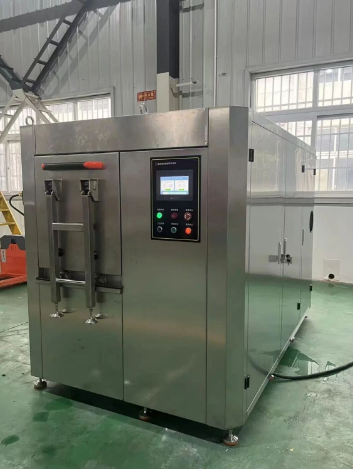
Industrial ultrasonic cleaning machines utilize high-frequency sound waves transmitted through a liquid medium to generate cavitation. During operation, microscopic bubbles continuously form and collapse near pipe walls and internal surfaces. The localized energy released during this process effectively breaks the bond between contaminants and the substrate.
In practical applications, this mechanism allows ultrasonic cleaning systems to remove oil films, scale, carbon deposits, and embedded particles from complex internal geometries, including bends, narrow channels, and welded joints. One of the key advantages from an operational perspective is that ultrasonic cleaning can often be performed without dismantling pipelines or critical components, making it suitable for on-site maintenance and preventive cleaning programs.
Why Ultrasonic Cleaning Works in Real Production Environments
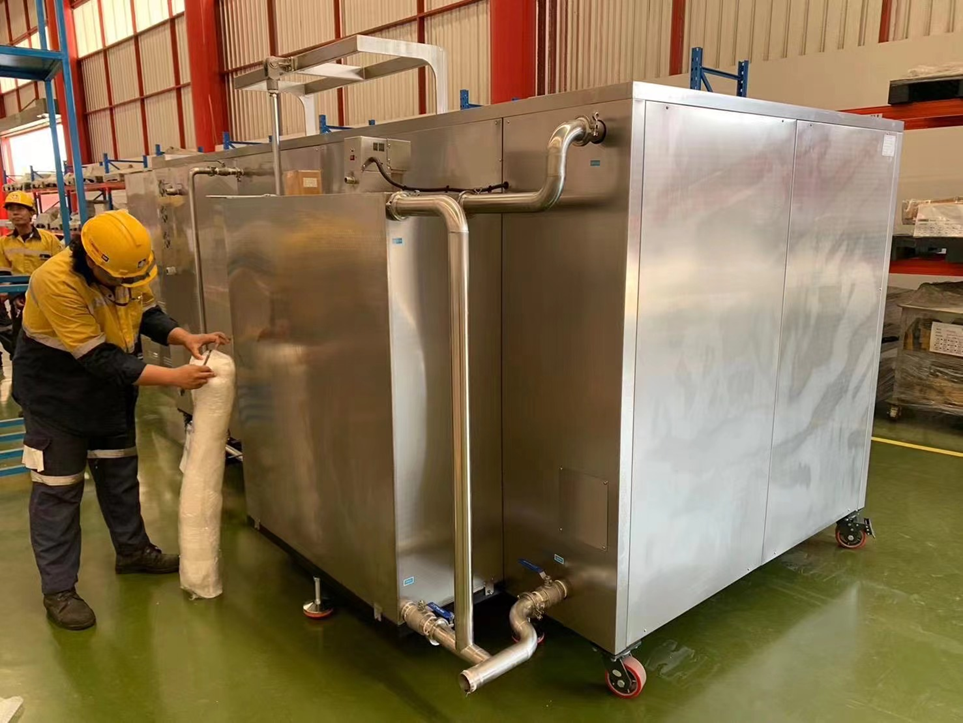
Compared with mechanical or chemical cleaning, ultrasonic cleaning offers several advantages that are particularly relevant to industrial users:
Non-invasive cleaning process
Ultrasonic cleaning does not rely on abrasion or aggressive chemical reactions. This helps protect pipe materials, internal coatings, weld seams, and precision surfaces, reducing the risk of long-term damage.
Effective cleaning of complex internal structures
Cavitation reaches areas that brushes, sprays, or manual methods cannot, making ultrasonic cleaning well suited for pipelines, heat exchangers, valves, and fittings with intricate internal features.
Reduced downtime and labor input
On-site ultrasonic cleaning minimizes disassembly requirements, shortening maintenance cycles and improving overall production continuity.
Stable and repeatable results
In industrial systems, consistency matters. By controlling ultrasonic power, frequency, and operating modes, cleaning performance can be reproduced reliably across multiple batches or maintenance cycles.
Key Process Parameters and Industrial Adaptability
In industrial applications, ultrasonic cleaning performance depends on selecting and controlling the right parameters based on actual operating conditions.
Ultrasonic Frequency
An operating frequency of 28 kHz is commonly used for industrial cleaning tasks requiring strong cavitation intensity. This frequency is well suited for removing heavy contamination from automotive components, marine parts, aerospace components, and industrial pipelines. In practice, frequency selection should be matched to both contamination type and material characteristics.
Cleaning Solution Selection
Most industrial ultrasonic cleaning processes use water-based solutions combined with mild detergents. For more demanding applications, weakly alkaline, hydrophilic cleaning agents may be employed to enhance contaminant removal while maintaining material compatibility and environmental compliance.
Cleaning Time
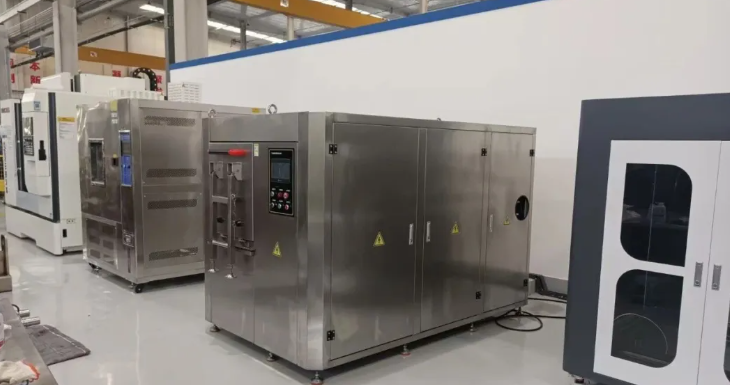
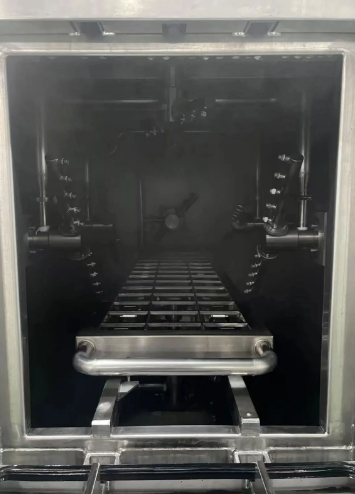
Typical cleaning cycles range from 10 to 30 minutes, depending on contamination severity, component size, and internal complexity. In production environments, cleaning time is usually optimized through testing to balance cleaning effectiveness and throughput.
Ultrasonic Cleaning vs. Spray Cleaning: A Manufacturer’s Perspective
From a manufacturing standpoint, ultrasonic cleaning machines and spray cleaning systems address different industrial cleaning needs, and the optimal solution depends on process requirements rather than technology preference.
Ultrasonic cleaning machines rely on high-frequency sound waves to generate cavitation within a liquid medium. In our experience, this technology is particularly effective for components and pipelines with complex internal structures, such as heat exchangers, valves, precision fittings, and pipes with bends or narrow channels. Because ultrasonic cleaning does not involve direct mechanical contact, it minimizes the risk of surface damage while delivering consistent cleaning performance in areas that are difficult to access using conventional methods.
Spray cleaning systems, on the other hand, use high-pressure jets combined with cleaning agents to physically remove contaminants. These systems are often preferred for large, heavy-duty components or production lines requiring high throughput, where robust mechanical action and fast cycle times are the primary considerations.
In practical industrial applications, the choice between ultrasonic cleaning and spray cleaning is not a question of superiority, but of process suitability. As a manufacturer, we often assist customers in evaluating their parts geometry, contamination type, and production workflow to determine whether ultrasonic cleaning, spray cleaning, or a combined solution will deliver the best long-term results in terms of cleaning quality, efficiency, and operating cost.
This makes ultrasonic cleaning systems a practical choice for manufacturers seeking reliable, on-site solutions for pipeline maintenance and preventive cleaning.
As manufacturing moves toward a smarter and greener future, Tense’s mission is to make industrial cleaning more precise, automated, and environmentally responsible. Through innovation and engineering excellence, we continue to support manufacturers worldwide in achieving cleaner production and higher efficiency — one intelligent system at a time.
Post time: Feb-02-2026