
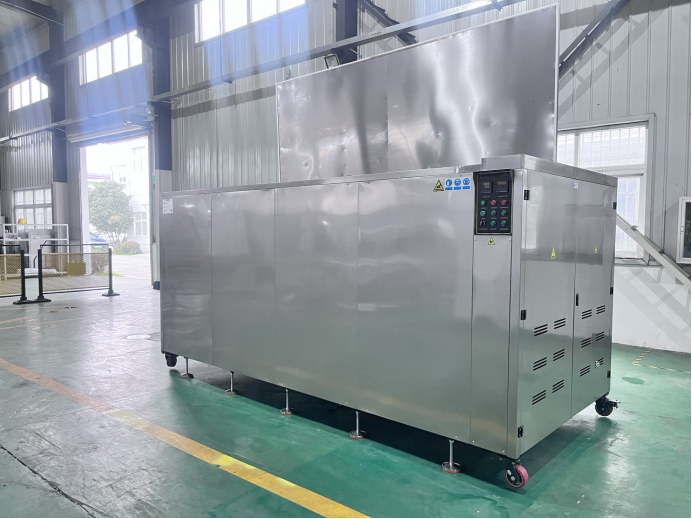
In heavy industrial environments, ultrasonic cleaning machines often operate for long hours under demanding conditions. Whether removing oil from metal parts, cleaning machining components, or maintaining industrial tools, the reliability of the ultrasonic transducer directly affects cleaning performance and machine lifespan.
At the core of every ultrasonic cleaning system is the PZT piezoelectric transducer, which converts electrical energy into high-frequency mechanical vibration. When designed and installed correctly, these transducers can deliver stable ultrasonic power for years of continuous operation.
At Tense Ultrasonic, we design industrial ultrasonic cleaning machines using high-quality PZT transducers to ensure strong cavitation, stable performance, and long service life in demanding industrial environments.
How Ultrasonic Cleaning Works?

Ultrasonic cleaning uses high-frequency sound waves, typically 28KHZ, transmitted through liquid in a cleaning tank.
These sound waves create microscopic bubbles in the liquid. When the bubbles collapse, they produce tiny but powerful shockwaves — a phenomenon known as cavitation.
This cavitation effect helps:
- remove oil and grease
- dislodge particles from surfaces
- clean complex shapes and small holes
- reach areas that brushes or sprays cannot access
The stronger and more stable the cavitation, the better the cleaning performance. That is why transducer quality plays a critical role in ultrasonic cleaning systems.
The Role of PZT Transducers in Industrial Ultrasonic Cleaners
Industrial ultrasonic cleaners typically use bolt-clamped Langevin transducers built with PZT ceramic elements.
A typical transducer consists of:
- multiple PZT ceramic discs
- a front mass (horn)
- a rear mass
- a central tightening bolt
- conductive electrodes
When an alternating electrical signal is applied, the PZT ceramics expand and contract rapidly, generating ultrasonic vibration. These vibrations are transferred into the cleaning tank and then into the liquid.
High-quality transducers ensure:
- stable ultrasonic frequency
- strong cavitation intensity
- efficient energy conversion
- long operational life
This is especially important for industrial cleaning systems that run continuously.

Challenges in Heavy-Duty Ultrasonic Cleaning
In heavy industrial environments, ultrasonic equipment faces several challenges that can affect transducer reliability.
Heat buildup
High-power ultrasonic operation can generate heat inside the transducer. Without proper cooling, excessive temperature may reduce output power or shorten the life of the ceramic elements.
Mechanical stress
Continuous vibration places mechanical stress on internal components. Poor assembly or incorrect preload may lead to fatigue or internal damage over time.
Cavitation erosion
Cavitation helps clean surfaces but can gradually erode metal parts of the tank if materials are not designed for industrial use.
Chemical exposure
Industrial cleaning solutions often contain alkaline or chemical detergents. Long-term exposure may cause corrosion if the tank and components are not made of suitable materials.
For this reason, industrial ultrasonic cleaners must be designed for durability and reliability.
How Tense Ultrasonic Ensures Long Transducer Life

At Tense Ultrasonic, reliability is a key priority in our equipment design.
Our ultrasonic cleaning machines incorporate several features to ensure stable long-term operation.
High-quality PZT materials
We use industrial-grade piezoelectric ceramics designed for high-power ultrasonic operation.
Precision assembly
Correct mechanical preload ensures optimal vibration transmission and protects the ceramic stack from damage.
SUS304 stainless steel tanks
Our ultrasonic cleaning tanks are manufactured from SUS304 stainless steel, providing strong resistance to cavitation and corrosion.
Stable ultrasonic generators
Our ultrasonic generators deliver stable frequency output and controlled power, reducing unnecessary stress on the transducers.
These design features allow our equipment to maintain strong ultrasonic performance during long operating cycles.
Applications of Industrial Ultrasonic Cleaning

Reliable ultrasonic cleaning systems are widely used in industries such as:
- automotive parts cleaning
- metal machining and degreasing
- aerospace components
- molds and tooling
- electronics parts washing
- industrial maintenance cleaning
In these environments, reliable ultrasonic equipment helps improve productivity and reduce downtime.
About Tense Ultrasonic
Tense Ultrasonic specializes in manufacturing industrial ultrasonic cleaning machines for global customers.
Learn more about our ultrasonic cleaning solutions:www.china-tense.net
Post time: Mar-31-2026