
Introduction
Ultrasonic cleaning is a powerful, non-abrasive process that uses high-frequency sound waves to remove grease, grime, rust, and other contaminants from parts. Industrial ultrasonic cleaning machines are widely used in automotive manufacturing, maintenance services, remanufacturing operations, electronics production, medical device cleaning, and many other industries.
For example, auto parts such as engine blocks, injectors, carburetors, bearings, and transmission components are commonly cleaned using ultrasonic cleaners to remove carbon deposits, machining oil, and metal particles. Compared with manual brushing or chemical soaking, ultrasonic cleaning reaches deep into blind holes, grooves, and complex geometries with minimal labor and consistent results.
One critical factor that determines ultrasonic cleaning performance is temperature. Heating the cleaning solution significantly improves cavitation intensity and chemical activity—but only up to a certain point. In real-world industrial applications, around 60°C (140°F) is widely regarded as the optimal operating temperature. It delivers maximum cleaning efficiency without compromising cavitation performance, part safety, or operator safety.
So why does 60°C work so well? The answer lies in thermodynamics, fluid behavior, and cavitation physics.
How Ultrasonic Cleaning Works
At its core, ultrasonic cleaning relies on a physical phenomenon known as cavitation.
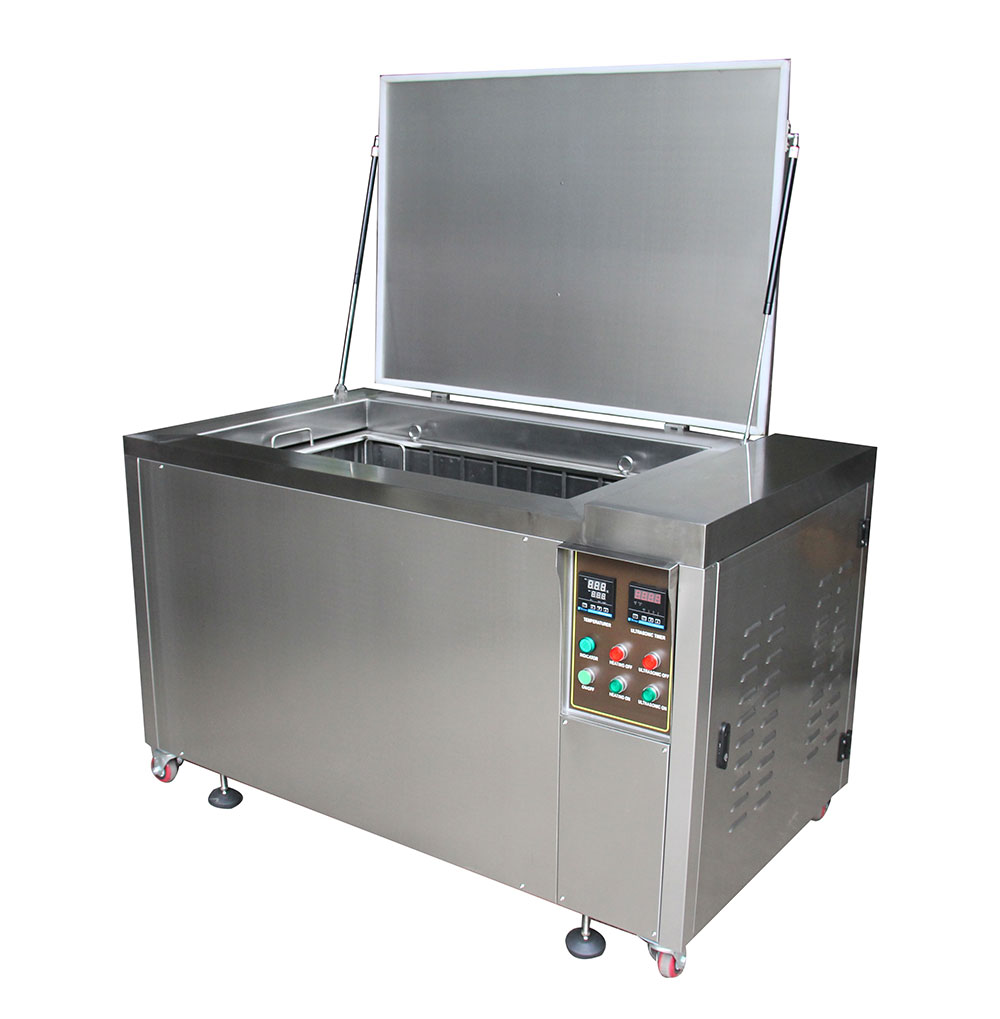
An ultrasonic cleaning machine uses ultrasonic transducers mounted to the tank walls or bottom. These transducers convert electrical energy into high-frequency mechanical vibrations, typically in the range of 20–40 kHz for industrial ultrasonic cleaners.
When these sound waves travel through the liquid cleaning solution, they create alternating high-pressure and low-pressure cycles. During the low-pressure phase, microscopic bubbles form in the liquid. During the high-pressure phase, these bubbles collapse violently.
This rapid formation and implosion of microbubbles releases intense localized energy in the form of shock waves and microjets. These forces:
-
Dislodge grease, oil, and particulate contamination
-
Penetrate tight crevices, blind holes, and internal channels
-
Break weak chemical bonds holding contaminants to surfaces
Because cavitation occurs uniformly throughout the liquid, ultrasonic cleaning provides thorough, repeatable results without damaging most metals and hard plastics.
The Role of Transducers and Cleaning Solutions
The ultrasonic transducer is the heart of the system. Most industrial machines use piezoelectric ceramic transducers that vibrate thousands of times per second. Their placement—bottom-mounted, side-mounted, or a combination—affects cavitation uniformity and cleaning consistency.
Equally important is the cleaning solution. Industrial ultrasonic cleaning rarely uses plain water. Instead, specialized detergents are added to:
-
Reduce surface tension
-
Improve wetting of part surfaces
-
Emulsify oils and greases
-
Chemically break down contaminants
Alkaline detergents are commonly used for oil and grease removal in auto parts cleaning and maintenance industries. Acidic solutions may be used for rust or scale removal, while neutral detergents are preferred for delicate components.
The interaction between cavitation and chemistry is crucial: cavitation loosens contaminants, while the cleaning solution dissolves and suspends them so they can be rinsed away.
Why Temperature Matters: The Thermodynamics Behind Ultrasonic Cleaning
Temperature has a profound influence on ultrasonic cleaning performance due to its impact on fluid properties and chemical reaction rates.
1. Reduced Viscosity and Surface Tension
As temperature increases, the cleaning solution becomes less viscous and its surface tension decreases. This makes it easier for cavitation bubbles to form, grow, and collapse with greater intensity.
Stronger bubble collapse means more energetic microjets striking the part surface, improving mechanical cleaning action.
2. Faster Chemical Reactions
Most chemical cleaning reactions accelerate as temperature rises. A common rule of thumb is that reaction rates approximately double for every 10°C increase.
At elevated temperatures, detergents dissolve more effectively, oils soften or liquefy, and stubborn residues break down faster. This dramatically improves overall cleaning efficiency.
3. Improved Degassing
Fresh cleaning solutions often contain dissolved air, which can dampen cavitation. Heating the liquid helps release this trapped gas, allowing cavitation bubbles to collapse more violently and consistently.
Why Too Much Heat Reduces Cleaning Performance
While heating improves ultrasonic cleaning, excessive temperature works against cavitation.
As the liquid approaches its boiling point, vapor-filled bubbles begin to form instead of true cavitation bubbles. These vapor bubbles do not collapse with the same intensity. Instead, they cushion the ultrasonic energy and reduce cleaning effectiveness.
In extreme cases, a thin vapor layer can form on the part surface, acting as an insulating barrier that blocks cavitation entirely. This phenomenon explains why ultrasonic cleaning performance often declines above 70–75°C.
Why 60°C Is the “Sweet Spot”
Based on thermodynamics, fluid mechanics, and industrial experience, around 60°C represents the optimal balance point for ultrasonic cleaning.
At this temperature:
-
Cavitation bubbles form easily and collapse with maximum energy
-
Cleaning solutions reach peak chemical activity
-
Oils, waxes, and grease soften or dissolve efficiently
-
Vapor formation remains minimal
-
Equipment operates safely and reliably
Below 40°C, cavitation intensity drops sharply and cleaning becomes slow. Between 50°C and 65°C, cavitation energy and chemical performance peak. Above 70°C, vapor interference begins to reduce cleaning efficiency.
Temperature vs. Cleaning Efficiency
| Cleaning Temperature | Cavitation Strength | Cleaning Efficiency |
|---|---|---|
| ≤ 40°C | Weak | Low |
| 40–50°C | Moderate | Good |
| 50–65°C | Strong | Excellent |
| 65–75°C | Declining | Reduced |
| ≥ 75°C | Poor | Inefficient |
This is why many industrial ultrasonic cleaning machines are designed to operate most efficiently around 60°C, especially for auto parts cleaning, maintenance, and remanufacturing applications.
Practical Tips for Operating at 60°C
To get the best results from your ultrasonic cleaning machine:
-
Preheat the bath before loading parts to ensure stable cavitation
-
Use detergents rated for elevated temperatures
-
Avoid overcrowding the tank, allowing ultrasonic waves to circulate freely
-
Use baskets or trays to keep parts off the tank bottom
-
Monitor cleaning time—higher temperatures require shorter cycles
-
Replace contaminated solutions regularly to maintain cavitation efficiency
Safety note: 60°C is hot enough to cause burns. Operators should wear protective gloves and avoid splashing.
Conclusion
Ultrasonic cleaning is a perfect example of physics and chemistry working together. Cavitation provides the mechanical force, cleaning solutions handle the chemistry, and temperature amplifies both.
Through thermodynamic optimization, 60°C emerges as the ideal operating temperature—hot enough to maximize cavitation intensity and chemical activity, yet cool enough to avoid vapor shielding and safety risks.
For industries such as auto parts cleaning, maintenance, and remanufacturing, operating at this temperature can significantly reduce cleaning time, improve consistency, and lower operating costs.
If you are looking for reliable, temperature-controlled ultrasonic cleaning equipment, China Tense offers a full range of industrial ultrasonic cleaning machines designed for high-efficiency performance across demanding applications.
Post time: Feb-03-2026