
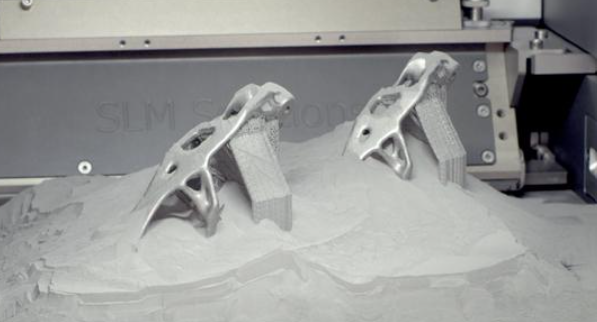
Trapped residual metal powder in complex metal 3D printed parts ruins surface finish and disrupts post-processing. Learn why combined spray and ultrasonic cleaning delivers efficient, thorough residual powder removal for metal additive manufacturing post-production.
Why Post-Print Cleaning Is Indispensable for Metal 3D Printed Parts
Metal additive manufacturing technologies, including Selective Laser Melting (SLM), Direct Metal Laser Sintering (DMLS), and Binder Jetting, have revolutionized modern precision manufacturing. These advanced techniques enable the fabrication of lightweight structural parts, intricate lattice frameworks, and precision internal cooling channels that are unachievable with traditional CNC machining and mechanical processing.
However, 3D printing is merely the initial stage of the complete manufacturing workflow. Before metal parts proceed to critical subsequent procedures—including precision inspection, secondary machining, heat treatment, surface coating, and final assembly—professionalpost-processing cleaning is non-negotiable. The core cleaning task is to eliminate residual metal powder, machining lubricants, and other microscopic contaminants adhering to part surfaces and hidden internal structures.
Unremoved residual contaminants will trigger a series of quality issues: degraded surface smoothness, weakened coating adhesion and peeling, cross-contamination of downstream production processes, blockage of tiny internal channels, and ultimately compromised structural stability and service reliability of finished metal 3D printed parts.
Limitations of Traditional Cleaning Methods for Metal 3D Printed Components
Different from conventionally machined metal parts with regular structures, metal 3D printed workpieces feature ultra-complex geometric designs, diverse porous surfaces, deep closed cavities, and crisscross internal flow channels. While these unique structures optimize part mechanical performance and functional attributes, they also form numerous narrow, dead-end spaces that easily trap fine metal powder particles.
Conventional cleaning approaches such as compressed air blowing, manual brush scrubbing, and ordinary high-pressure water washing can only strip loose, surface-exposed powder particles. They fail to reach deep internal cavities and tiny lattice gaps, leaving stubborn fine powder residues. This leads toinconsistent cleaning results, frequent rework, excessive labor input, and low overall post-processing efficiency for manufacturers.
Core Advantages of Ultrasonic Cleaning for Metal 3D Printing Post-Processing
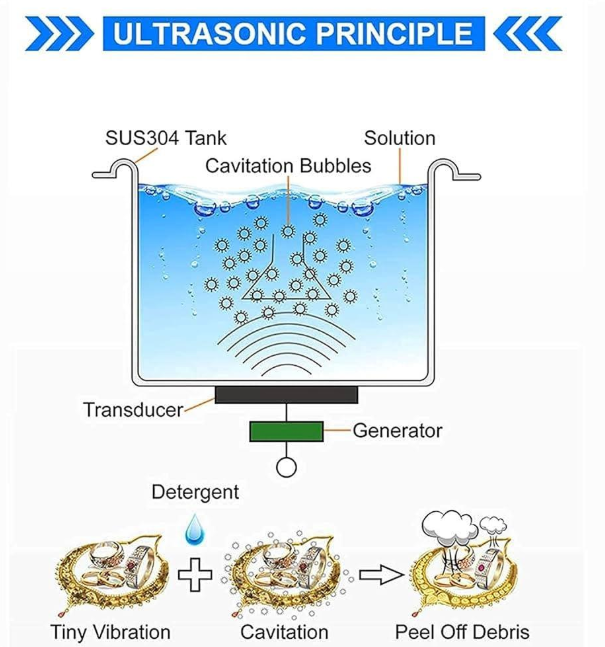
Ultrasonic cleaning is a high-efficiency precision cleaning technology tailored for complex structural parts, relying on high-frequency ultrasonic cavitation to achieve full-scale decontamination. The system generates countless microscopic cavitation bubbles uniformly throughout the professional cleaning solution. These bubbles continuously form, expand, and violently collapse, releasing instantaneous localized high energy and micro impact waves.
This cavitation cleaning mechanism breaks the limitations of physical contact cleaning. It can penetrate inaccessible areas including narrow internal channels, blind holes, dense lattice structures, and deep cavities of metal 3D printed parts. It thoroughly strips stubborn residual powder and micro contaminants without damaging part surfaces or precision structures, delivering uniform, high-quality cleaning effects and greatly reducing manual operation dependence.
Why Integrated Spray & Ultrasonic Cleaning Outperforms Single-Method Cleaning
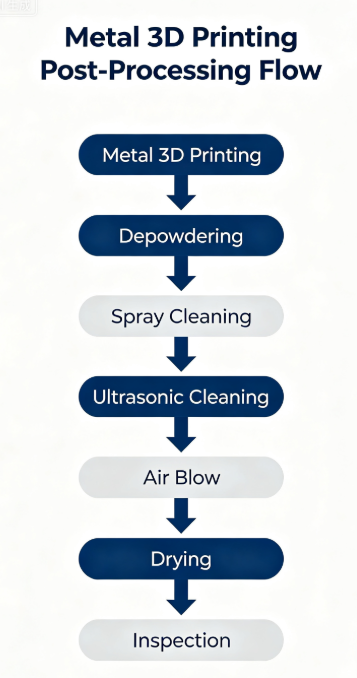
Spray cleaning and ultrasonic cleaning are highly complementary, and their integrated combination achieves a layered, thorough cleaning effect that single cleaning technology cannot match.
High-flow spray cleaning acts as the first cleaning stage: it uses high-pressure flowing water to quickly flush away loose surface powder, large particle impurities, and residual oil stains on the outer surface of 3D printed parts, removing most superficial contaminants efficiently. The subsequent ultrasonic cavitation cleaning serves as the precision finishing stage, targeting fine residual powder trapped in internal gaps and complex structures.
Combining the two technologies in one automated cleaning cycle effectively avoids secondary particle redeposition, eliminates cleaning dead zones, stabilizes cleaning consistency, and significantly improves the overall efficiency of metal 3D printing post-processing workflows.
TENSE Automated Cleaning System: Custom Solution for Metal 3D Printed Parts
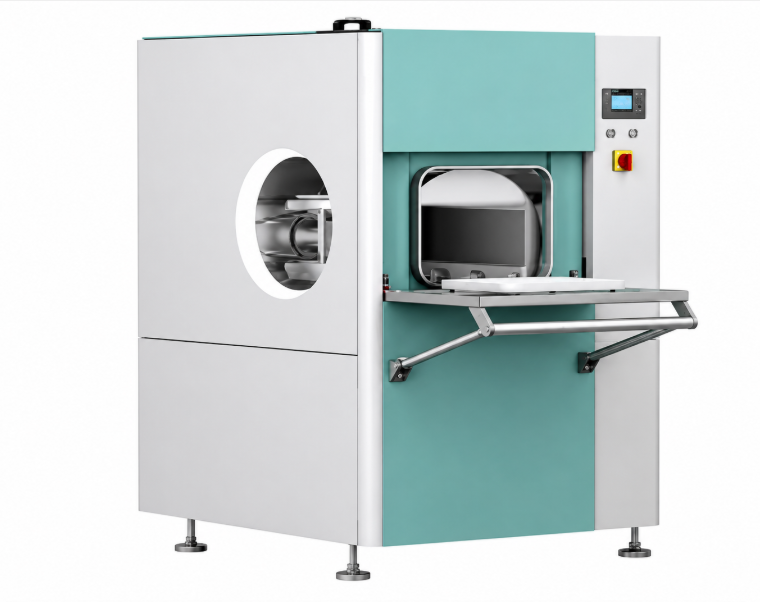
The
TENSE 3D Printing Parts Cleaning Machine is a professional integrated cleaning device customized for metal additive manufacturing post-processing. It organically integrates high-pressure spray cleaning,high-frequency ultrasonic precision cleaning, automatic basket rotation, and air drying blowing into a fully automated one-stop workflow.
Equipped with dual high-power spray pumps, a40kHz industrial-grade ultrasonic cleaning system, 360° rotating cleaning basket, PLC intelligent touch screen control, automatic liquid level replenishment, and digital constant temperature control module, plus a built-in air blowing drying stage, this all-in-one system solves the pain points of inconsistent manual cleaning and low efficiency. It enables standardized, repeatable high-precision cleaning quality, reduces manual intervention costs, and shortens the entire production cycle of metal 3D printed parts.
Key Application Scenarios
This professional automated cleaning solution is widely applicable to high-precision metal parts manufactured via additive manufacturing. Typical application fields include aerospace precision components, automotive lightweight structural parts, medical implant devices, mold tooling inserts, industrial heat exchangers, and robotic precision parts. It delivers the most prominent cleaning advantages for 3D printed workpieces with complex internal channels, dense lattice structures, and porous precision surfaces.
Conclusion
With the continuous upgrading and widespread application of metal additive manufacturing technology, standardized and high-precision post-print cleaning has become a core link to guarantee finished part quality and production process stability. Adopting an integrated automated cleaning system that combines spray flushing, ultrasonic cavitation cleaning, intelligent rotation, and PLC precise control enables manufacturers to completely remove residual metal powder and micro contaminants. It effectively improves the yield rate of metal 3D printed parts and provides reliable quality assurance for subsequent heat treatment, coating, assembly, and other downstream processes.
FAQ
1. Can ultrasonic cleaning remove residual powder from internal channels of 3D printed parts?
Absolutely yes. The ultrasonic cavitation effect drives the cleaning solution to fully penetrate narrow internal channels, blind holes and tiny gaps. It can effectively strip and wash away trapped fine metal powder that cannot be removed by traditional cleaning methods.
2. Is ultrasonic cleaning applicable to different metal 3D printing materials?
Yes. With matched professional cleaning solutions, this ultrasonic cleaning technology is suitable for almost all common 3D printing metal materials, including titanium alloy, stainless steel, aluminum alloy, Inconel superalloy, and other precision metal materials, causing no damage to part surfaces and structures.
3. What are the benefits of combining spray cleaning with ultrasonic cleaning?
The dual-process combination realizes graded efficient cleaning. Spray cleaning quickly removes large loose surface contaminants to reduce ultrasonic cleaning load, while ultrasonic cleaning eliminates hidden fine residues in complex structures. The whole process achieves zero cleaning dead zones, more thorough decontamination and more stable cleaning results.
4. Which industries benefit most from this automated 3D part cleaning solution?
It brings significant value to multiple high-precision manufacturing industries, including aerospace, automotive manufacturing, medical equipment, mold processing, new energy, and precision mechanical engineering.
Post time: Jul-10-2026