
Ultrasonic Power Density Explained: How Many Watts Per Liter Do You Need?
When buyers compare industrial ultrasonic cleaners, the most prominent number on the spec sheet is usually total power—2,000 watts, 4,000 watts, 6,000 watts. That number on its own is almost meaningless.
The specification that actually predicts cleaning performance is power density: watts per liter of tank capacity.
What Is Ultrasonic Power Density?
The Basic Calculation
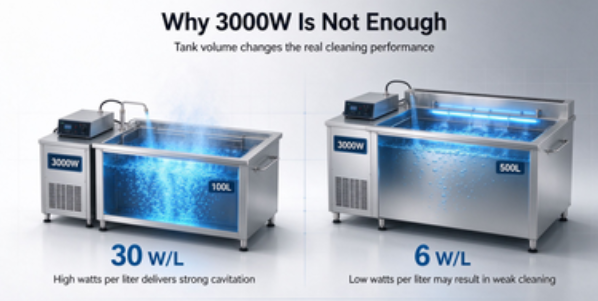
Power Density (W/L) = Total Ultrasonic Power (W) ÷ Tank Volume (L)
It describes how much acoustic energy is available in each liter of solution. A 1,200-watt machine with a 100-liter tank has a power density of 12 W/L.
Why Power Density Matters More Than Total Power
Cleaning performance depends on the energy density in the volume where the parts actually sit, not on the headline wattage of the generator. Power density directly determines:
Nominal Power vs. Effective Power
“Ultrasonic power” may be quoted in several ways, often misleading buyers:
- Generator input power: Largest but least relevant number.
- Generator output power: Closer to the truth.
- Effective ultrasonic power: The only figure that produces cavitation.
How to Compare Apples to Apples:
1. Is the power generator input, output, or effective acoustic power?
2. Is the volume total volume or working volume above transducers?
3. How many transducers are installed and what is their individual rating?
What Power Density Do Different Jobs Need?
| Cleaning Duty | Range (W/L) | Typical Applications |
|---|---|---|
| Light-Duty | 5–8 W/L | Optics, electronics, dust, fingerprints |
| General-Purpose | 8–12 W/L | Automotive components, industrial grease, maintenance |
| Heavy-Duty | 12–20+ W/L | Hard carbon, rust, scale, aged varnish |
Lift Ultrasonic Cleaner TS-UD Series
Short Description: The industry standard range of ultrasonic cleaning equipment ranges from 140 to 2300 liters capacity. They are designed for cleaning and descaling of all types of parts, components and accessories.
All equipment in this line can incorporate a lifting platform that facilitates loading and unloaing of parts. They can also carry systems of filtration, separation of oils and water treatments.
How Power Density Interacts with Other Parameters
Frequency
28 kHz: Heavy soils on steel/iron.
40 kHz: Versatile general-purpose.
80 kHz: Delicate precision parts.
Tank Loading
Parts and baskets displace liquid. Overloading reproduces symptoms of under-powering: long cycles and weak spots.
How to Verify Power Density Yourself
The Aluminum Foil Test
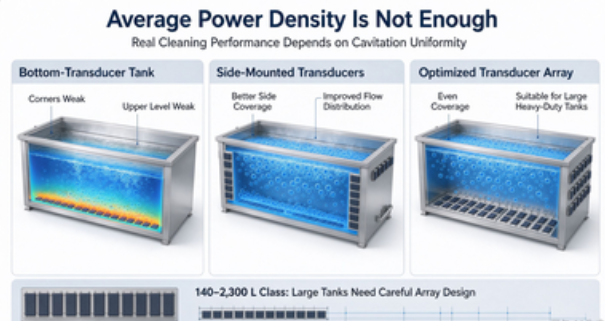
Suspend a sheet of ordinary aluminum foil in the degassed bath for 1–2 minutes. Proper cavitation produces a uniform pattern of tiny indentations. Dead zones appear smooth.
Buying Recommendations
- Define the hardest soil first.
- Choose frequency, then tank size.
- Calculate power density on effective power.
- Ask for a cavitation map or cleaning trial.
FAQ
Q: What is a good watts-per-liter value for automotive parts cleaning?
A: Most automotive repair—general grease and oil—is served by 8–12 W/L. Heavy carbon and scale require 12–20 W/L.
Q: Can I just divide the generator’s wattage by the tank volume?
A: Only if it’s effective acoustic power. If it’s input power, the calculation will overstate the real density.
Q: Will higher power density damage my parts?
A: Yes, if misapplied. Soft metals like aluminum can erode. Use higher frequency for delicate parts.
“Total power is a marketing number; power density is an engineering number.”。
For help calculating the power density suited to your requirements, contact Tense.
Post time: Nov-05-2026