
Introduction
In the competitive world of automotive parts manufacturing, every second counts. Production lines are optimized for maximum throughput, and any bottleneck in the process costs money. For many manufacturers, the parts cleaning station is one of those bottlenecks. Whether it is removing cutting oils after machining, degreasing stamped parts before assembly, or preparing surfaces for coating, cleaning often takes longer than it should and slows down the entire line. But a growing number of automotive parts manufacturers are finding that switching to industrial ultrasonic cleaner technology can cut cleaning time dramatically—often by 70% or more. In this article, we look at how ultrasonic cleaning is transforming parts cleaning in the automotive manufacturing industry.
The Cleaning Bottleneck in Automotive Manufacturing
Why Cleaning Is Often the Slowest Step
On a modern automotive parts production line, most steps are highly automated and optimized. CNC machines produce parts in minutes. Stamping presses form components in seconds. Assembly lines put them together at a rapid pace. But then the parts go to cleaning—and everything slows down.
Why is cleaning such a bottleneck? There are several reasons:
Traditional methods are slow: Spray washers, tumble washers, and manual cleaning stations all have relatively long cycle times compared to other manufacturing steps. A part that takes 2 minutes to machine might take 10–15 minutes to clean.
Batch processing: Many cleaning systems process parts in batches, which means parts spend time waiting in a queue before and after cleaning.
Multiple stages: Effective cleaning often requires multiple stages—pre-wash, main wash, rinse, dry—each adding time to the process.
Manual handling: Parts often need to be manually loaded and unloaded, adding labor time and creating opportunities for delays.
The result is that cleaning becomes the rate-limiting step in the production process. No matter how fast the machining or assembly stations are, the line can only go as fast as the cleaning station.
The Cost of Slow Cleaning
A slow cleaning process costs manufacturers in several ways:
- Lost production: If cleaning is the bottleneck, the entire line’s throughput is limited by cleaning speed. Every part per hour you cannot clean is a part you cannot sell.
- Work-in-progress inventory: Parts waiting to be cleaned tie up capital and take up floor space.
- Labor costs: Longer cleaning times mean more labor hours per part.
- Energy costs: Running cleaning equipment for longer periods consumes more energy.
- Quality issues: Rushed cleaning to keep up with production often leads to inconsistent results and rework.
For a high-volume automotive parts manufacturer, even a 10% improvement in cleaning speed can translate into significant cost savings and increased revenue. A 70% improvement can be transformative.
How Ultrasonic Cleaning Cuts Time
Faster Cleaning Action
The most obvious way ultrasonic cleaning saves time is by cleaning faster than traditional methods. The cavitation action of an ultrasonic cleaning machine is incredibly efficient at removing contaminants from metal surfaces.
Here is why it is so fast:
- Simultaneous cleaning of all surfaces: Every surface of the part is cleaned at the same time, not just the surface facing a spray nozzle or brush
- Intensive scrubbing action: Billions of cavitation bubbles imploding every second create a powerful scrubbing effect
- Enhanced chemical action: Cavitation accelerates chemical reactions between the detergent and the soil
- Deep penetration: Cavitation reaches into crevices and holes that spray cannot reach, eliminating the need for rework
For many common automotive manufacturing soils—cutting oils, stamping lubricants, machining chips—ultrasonic cleaning can achieve complete removal in a fraction of the time required by spray washing or manual methods.
One-Stage vs. Multi-Stage Processing
Another time-saving benefit of ultrasonic cleaning is that it can often replace multi-stage cleaning processes with a single stage.
A typical spray washing line might have:
- Pre-wash stage
- Main wash stage
- Rinse stage
- Blow-off stage
Each stage adds time to the process. With ultrasonic cleaning, the main wash stage is so effective that you may be able to eliminate the pre-wash stage entirely. And because ultrasonic cleaning is so thorough, you may not need as many rinse stages either.
This consolidation of stages reduces both the total processing time per part and the footprint of the cleaning system.
Reduced Rework Time
Perhaps the most underappreciated time savings from ultrasonic cleaning comes from reduced rework. When parts come out of the cleaner properly cleaned the first time, you do not have to spend time re-cleaning the ones that did not pass inspection.
With traditional cleaning methods, it is common to have a rework rate of 5–15%—parts that need to go through the cleaner a second time because they did not pass the cleanliness check. With ultrasonic cleaning, rework rates of less than 1% are typical.
Over the course of a day, week, or year, eliminating that rework time adds up to significant savings.
Labor Time Savings
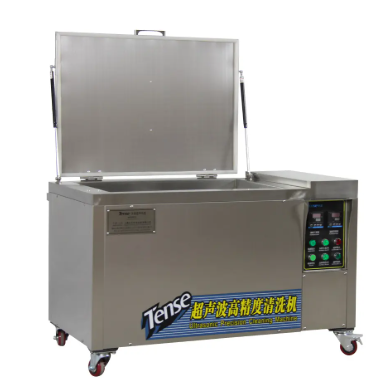
Ultrasonic cleaner TS series
Short Description:
TS series has been specifically designed for the cleaning and degreasing of all type of parts and components in Automotive industry. It achieves excellent cleaning results in many types of materials, especially in complex parts, where the ultrasounds have excellent results thanks to its high penetration capacity. Thus, the results while cleaning automobile engines are spectacular, even in those smaller and delicate parts.
Our Automotive series uses 28 kHz frequency with which the best results for the Automotive Sector are achieved.
Ultrasonic cleaning is also much less labor-intensive than manual or semi-automated cleaning methods. An operator simply loads parts into a basket, sets the timer, and presses start. While the cleaning cycle runs, the operator is free to do other work.
This means:
- One operator can manage multiple cleaning stations
- Less time is spent on hands-on cleaning
- Operators can focus on higher-value tasks
- Training time for new operators is minimal
For manufacturers running multiple shifts, the labor savings from switching to ultrasonic cleaning can be substantial.
Real-World Results from Automotive Manufacturers
Case Study: Machined Aluminum Components
A manufacturer of machined aluminum automotive components was using a spray washer to remove cutting oil from parts after machining. The cycle time was 12 minutes per batch, and the rework rate was about 8% due to oil residue in threaded holes and internal passages.
After switching to a 40 kHz industrial ultrasonic cleaner, the results were dramatic:
- Cycle time reduced from 12 minutes to 3 minutes (75% reduction)
- Rework rate dropped from 8% to less than 1%
- One operator could manage two cleaning stations instead of one
- Parts were cleaner, with no residual oil in holes or passages
The manufacturer calculated that the ultrasonic system paid for itself in less than 6 months through increased throughput and reduced labor costs.
Case Study: Stamped Steel Parts
A stamping plant producing automotive body panels and structural components was using a tumble washer to remove stamping lubricant from parts. The process was slow—15 minutes per batch—and parts often had residual lubricant in flanges and crevices.
After installing an ultrasonic cleaning line:
- Cleaning time per batch dropped from 15 minutes to 4 minutes (73% reduction)
- Cleanliness improved significantly, with no residual lubricant in hard-to-reach areas
- Energy consumption decreased because the ultrasonic system used less power than the tumble washer
- The plant was able to increase production without expanding the cleaning area
Case Study: Transmission Valve Bodies
A transmission component manufacturer was struggling to clean valve bodies with complex internal hydraulic passages. Spray washing could not reach the internal passages, and manual cleaning was too slow for production volumes.
Implementing ultrasonic cleaning solved both problems:
- Internal passages were completely cleaned—something spray washing could not achieve
- Cycle time went from 20 minutes (spray + manual touch-up) to 5 minutes (75% reduction)
- First-pass quality improved from 70% to over 99%
- The company was able to take on more production volume without adding cleaning staff
Why the Time Savings Are So Significant
It’s Not Just Faster Cleaning—It’s Better Cleaning
The 70%+ time savings that many manufacturers achieve with ultrasonic cleaning is not just because the cleaning action is faster. It is also because the cleaning is more thorough, which eliminates the need for rework, touch-ups, and multiple passes.
With traditional cleaning methods, you often have a choice: clean fast but accept lower quality, or clean slow to get better results. Ultrasonic cleaning gives you both—faster and better.
The Compound Effect of Time Savings
Time savings in cleaning have a compound effect on the rest of the production line:
- Increased throughput: Faster cleaning means more parts per hour through the entire line
- Reduced WIP: Less work-in-progress inventory sitting at the cleaning station
- Smoother flow: Eliminating the cleaning bottleneck creates a more balanced, efficient production flow
- More capacity: The same floor space and staff can produce more parts
For many manufacturers, the increased production capacity enabled by faster cleaning is the biggest benefit of all.
Implementing Ultrasonic Cleaning in Your Production Line
Choosing the Right System
Not all ultrasonic cleaners are created equal. To achieve the kind of time savings described above, you need a system that is properly sized and configured for your specific application.
Key considerations:
- Tank size: Must accommodate your largest parts and production volume
- Frequency: Match the frequency to your parts and soil type
- Power: Sufficient ultrasonic power for the tank volume and application
- Heating: Integrated heating for optimal cleaning performance
- Filtration: Continuous filtration to maintain solution quality
- Controls: Digital controls for consistent, repeatable results
The TS Series of ultrasonic cleaning machine systems from Tense, for example, are designed specifically for industrial and automotive applications, with robust construction, reliable performance, and configurable options to suit different production requirements.
Integrating with Existing Processes
Switching to ultrasonic cleaning does not have to mean a complete overhaul of your production line. Many manufacturers start by replacing one cleaning station with an ultrasonic unit and then expand as they see the results.
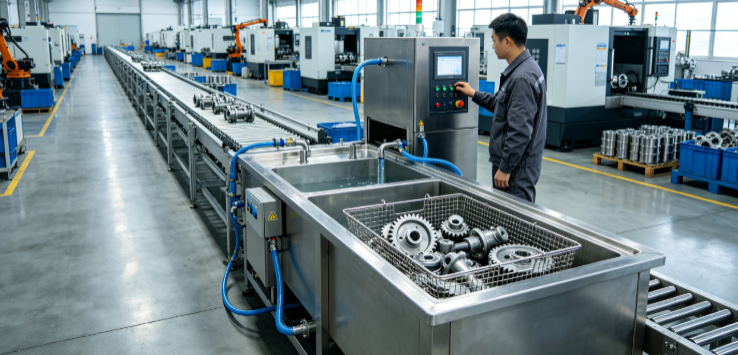
Key integration considerations:
- Part handling: How will parts be loaded and unloaded?
- Rinse and dry: Do you need additional rinse or drying stages?
- Workflow: How does cleaning fit into your overall production flow?
- Utilities: Do you have the necessary power, water, and drainage?
With proper planning, integrating ultrasonic cleaning into an existing production line can be done with minimal disruption.
Optimizing for Maximum Speed
To get the fastest possible cleaning times from your ultrasonic system:
Use the right detergent: A high-quality detergent formulated for your specific soil type will clean faster than a generic cleaner.
Optimize temperature: Running at the optimal temperature for your detergent and soil type maximizes cleaning speed.
Pre-clean when necessary: For parts with very heavy soil, a quick pre-rinse can reduce ultrasonic cycle time.
Maintain the solution: Clean solution with proper detergent concentration works faster and more consistently.
Load parts properly: Good part loading ensures maximum exposure to ultrasonic energy and faster cleaning.
Conclusion
For automotive parts manufacturers, cleaning has long been a necessary evil—slow, labor-intensive, and often a bottleneck in the production process. But that is changing as more manufacturers discover the benefits of industrial ultrasonic cleaner technology.
By replacing traditional cleaning methods with ultrasonic cleaning, manufacturers are cutting cleaning time by 70% or more while simultaneously improving cleanliness quality. The time savings come from faster cleaning action, reduced rework, lower labor requirements, and the elimination of multiple processing stages. The result is higher throughput, lower costs, and better quality—all from a single technology upgrade.
If your parts cleaning process is slowing down your production line, it may be time to explore what ultrasonic cleaning can do for you. To learn more about how automotive parts manufacturers are using ultrasonic technology to improve their operations, visit Tense to see the full range of industrial ultrasonic cleaning solutions.
FAQ
Q: How much time can I really save by switching to ultrasonic cleaning?
A: Most manufacturers see cleaning time reductions of 50–80% when switching from traditional methods like spray washing or manual cleaning. The exact savings depend on your specific parts, soil type, and current process.
Q: Will ultrasonic cleaning work for all types of automotive parts?
A: Ultrasonic cleaning is effective for most metal automotive parts, including machined components, stamped parts, castings, and assemblies. It works on steel, aluminum, brass, and most other common automotive materials.
Q: Do I need to change my entire production line to use ultrasonic cleaning?
A: No. Many manufacturers start by replacing a single cleaning station with an ultrasonic unit and then expand as they see the results. Ultrasonic cleaners can be integrated into existing production lines with minimal disruption.
Q: Is ultrasonic cleaning more expensive than traditional methods?
A: While the upfront cost of an ultrasonic cleaner may be higher than some traditional methods, the total cost of ownership is usually lower due to reduced labor, lower chemical consumption, less rework, and higher throughput. Most systems pay for themselves within 6–18 months.
Post time: Sep-04-2026