
How to Clean Large Heavy Parts Efficiently?

Why Are Large Industrial Parts More Difficult to Clean?

Large industrial parts are the core components of mechanical equipment manufacturing, including engine blocks, transmission housings, hydraulic cylinders, industrial castings and other heavy-duty workpieces. Before final assembly, these components undergo complex machining, forging and polishing processes, inevitably accumulating various stubborn contaminants such as machining chips, abrasive particles, metal debris, residual cutting fluids and rust preventive oils. Effective large parts cleaning is the key link to guarantee product qualification. If these pollutants are not completely removed, they will directly interfere with dimensional inspection accuracy, surface coating adhesion and precision assembly effects, and even reduce the long-term operational stability and service life of finished industrial equipment.

Unlike ordinary daily cleaning, professional industrial cleaning system focuses on removing microscopic residual pollutants rather than only cleaning visible surface dirt. Standardized industrial parts washer cleaning processes can effectively control component contamination, improve overall product quality, and ensure the smooth progress of subsequent processing and assembly procedures, which is an indispensable part of modern precision manufacturing.
The structural characteristics of large industrial parts determine their cleaning difficulty. Most oversized workpieces have complex geometric designs, with dense threaded holes, deep bores, closed internal cavities and narrow enclosed passages. These hidden structures are extremely easy to trap tiny metal debris and viscous cutting fluids, which are difficult to completely remove through conventional cleaning methods. In addition, the super size and heavy weight of heavy machinery parts bring great challenges to manual handling, not only greatly increasing labor intensity, but also easily causing safety accidents in the cleaning process.
Traditional cleaning methods also expose obvious defects in heavy parts cleaning scenarios. The immersion cleaning process requires a huge amount of cleaning solution and needs continuous heating to maintain the working temperature, resulting in high energy consumption and low cleaning efficiency. Manual washing relies entirely on the operator’s experience and proficiency, leading to inconsistent cleaning results and high error rates. Although high-pressure single-point cleaning can remove loose surface contaminants on exposed parts, it cannot penetrate complex internal structures, leaving residual oil stains and metal particles. For manufacturers engaged in large casting processing and heavy machinery manufacturing, selecting professional and efficient spray parts washer equipment is the core way to balance cleaning quality and production efficiency.

Choosing the Right Cleaning Equipment for Large Industrial Parts
6e75ea37e0e3458323637d9b9fa77660


When configuring cleaning equipment for oversized and heavy industrial components, cleaning performance is not the only evaluation standard. Manufacturers also need to comprehensively consider equipment load capacity, operational stability, energy-saving performance, and the ability to achieve consistent cleaning of complex surfaces, so as to match long-term production needs.
Among various industrial cleaning technologies, rotary spray cleaning has become the most practical solution for large industrial parts cleaning by virtue of its high efficiency and full coverage advantages. Different from traditional fixed-point cleaning and manual flip cleaning, the rotary platform design enables the workpiece to rotate 360 degrees synchronously during cleaning, so that all surfaces can be evenly impacted by high-pressure cleaning fluid, realizing full coverage cleaning and greatly reducing manual intervention.
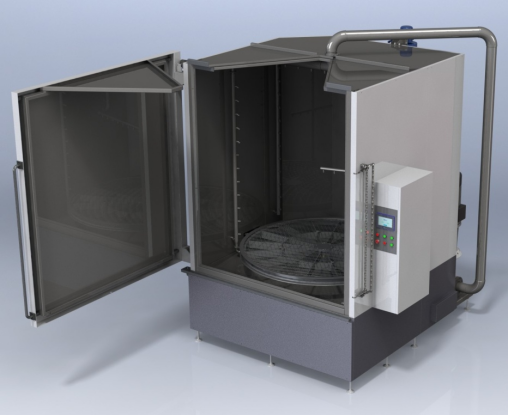
The TS-WP Series Rotary Spray Parts Washer is professionally customized for large parts cleaning scenarios, perfectly solving the cleaning pain points of heavy workpieces and complex structural components. This high-performance rotary spray washer adopts full PLC intelligent control, and operators can flexibly set core cleaning parameters such as spray pressure, cleaning time and solution temperature through the intuitive touch screen interface, with simple operation and high controllability.

In actual production, after the large industrial parts are stably placed on the rotary table of the TS-WP Series Rotary Spray Parts Washer through professional lifting equipment, the equipment automatically closes the cleaning chamber and starts the intelligent cleaning cycle. The 360-degree rotating platform cooperates with multi-directional distributed high-pressure spray nozzles to perform all-round dead-angle-free flushing on the workpiece surface, deep holes and internal gaps. While ensuring thorough removal of grease, metal chips and processing residues, the equipment is equipped with an efficient filtration and circulation system, which can filter and recycle the cleaning solution, effectively reducing water resource waste and production operating costs.
This automated automated parts washing mode completely avoids the instability of manual cleaning, realizes standardized and consistent cleaning effects, and is specially suitable for large castings, heavy welding parts, engineering machinery components and various oversized industrial workpieces that are difficult to clean by traditional processes. For manufacturing enterprises pursuing high-precision cleaning and high-efficiency production, the TS-WP Series Rotary Spray Parts Washer is a cost-effective and reliable industrial parts washer solution.

Practical Engineering Tips for Cleaning Large Heavy Parts

The final effect of heavy parts cleaning depends on both professional rotary spray washer equipment and standardized process design and daily maintenance. Reasonable operation specifications can maximize the performance of industrial cleaning system and stabilize product cleaning quality.
First, standardize workpiece handling and transportation. All oversized and heavy machinery parts must be transported and positioned with professional lifting equipment, and manual moving and flipping are strictly prohibited. This standardized operation can not only avoid workpiece collision and deformation, protect the precision structure of parts, but also prevent equipment damage and personnel safety risks, and create a safe production environment forlarge parts cleaning.
Second, customize cleaning parameters according to pollution types. Different contaminants such as thick grease, viscous cutting fluid and accumulated metal chips have different removal difficulties. Operators need to adjust the spray pressure, select matching cleaning agents and set reasonable cycle cleaning time according to the actual pollution situation of large industrial parts. Blindly extending the cleaning time cannot improve the cleaning effect, and only targeted parameter optimization can maximize the working efficiency of the spray parts washer.
Third, strengthen the daily maintenance of cleaning solution and equipment. Regularly clean the filtered impurities and suspended pollutants in the cleaning solution to ensure the filtration and circulation efficiency of the system. Stable cleaning solution quality can maintain the lasting and stable cleaning performance of the industrial parts washer, while effectively extending the service life of the cleaning fluid and core equipment components, reducing enterprise maintenance costs.
Finally, reserve expansion space for production. When selectingautomated parts washing equipment, enterprises should comprehensively consider current production volume and future capacity expansion needs. Prioritize theTS-WP Series Rotary Spray Parts Washer with large load capacity, intelligent automatic control and efficient liquid circulation functions, which can efficiently adapt to the growth of production volume and continuously improve the overall efficiency of large industrial parts cleaning production lines.

Model

TS-L-WP1200

TS-LWP1400

TS-L-WP1600

TS-L-W1800

Dimension (mm)

2000×2000×2200

2200 x 2300 x  2450

2480×2420×2550

2680 x 2650 x 4030

Turntable Dimete(mm)

1200

1400

1600

1800

tank volume (ltr.)

800

1100

1350

1650

Cleaning height(mm)

1000

1000

1200

2500

Load capacity (kgs)

1000

1000

2000

4000

Heating power ( Kw)

27.0

27.0

27.0

33

Pump (Kw)

7.5

7.5

11

22

Cleaning pressure (Bar)

6-7

6-7

6-7

6-7

Cleaning flow( L/min)

400

400

530

1400


Frequently Asked Questions (FAQ)

1. What is the best way to clean large industrial parts?

The optimal cleaning method needs to be determined according to the workpiece size, pollutant type and required cleanliness standard. For large castings, steel structural parts and heavy machinery parts with complex structures, automated rotary spray washer cleaning is the best solution. Represented by the TS-WP Series Rotary Spray Parts Washer, this industrial parts washer equipment can realize full-coverage and high-consistency cleaning, greatly reduce manual labor investment, and significantly improve cleaning efficiency and workplace safety compared with traditional manual cleaning.

2. What contaminants are commonly found on large industrial parts?

After machining, forging and assembly processing, large industrial parts are usually attached with various pollutants, including metal machining chips, tiny abrasive particles, residual cutting fluids, anti-rust oil, industrial grease, polishing residues and surface dust. If these pollutants cannot be completely removed through professional large parts cleaning, they will seriously affect component detection accuracy, coating adhesion and assembly precision, and reduce the reliability of finished mechanical equipment.

3. Why is manual cleaning not suitable for large heavy parts?

Manual cleaning of heavy machinery parts has obvious limitations. It not only consumes a lot of labor and has low efficiency, but also cannot guarantee consistent cleaning quality. For deep holes, internal cavities and recessed hidden structures of large industrial parts, manual cleaning is difficult to penetrate thoroughly, resulting in residual pollutants. The automated parts washing mode of professional spray parts washer can perfectly solve these problems, stabilize cleaning effects, reduce operator fatigue and eliminate potential safety hazards.

4. How does a rotary spray parts washer work?

The core working principle of a rotary spray washer is enclosed rotary high-pressure spray cleaning. The large industrial parts are fixed on the internal rotary turntable of the equipment. With the 360-degree rotation of the turntable, the multi-directional high-pressure spray nozzles continuously flush all accessible surfaces of the workpiece. At the same time, the supporting filtration and circulation system realizes the recycling of cleaning solution, which not only ensures uniform and thorough cleaning effect, but also saves water resources and cleaning costs, which is the mainstream technology of modern industrial cleaning system.

5. What should be considered when choosing a large industrial parts washer?

Enterprises need to comprehensively evaluate multiple core factors when selecting industrial parts washer equipment, including workpiece size range, maximum load capacity, conventional pollutant types, daily production volume, equipment spray pressure, filtration and recycling capacity and automation level. It is recommended to select equipment that matches current cleaning needs and can adapt to future capacity expansion, such as the TS-WP Series Rotary Spray Parts Washer, to improve long-term heavy parts cleaning efficiency and reduce comprehensive operating costs.

6. Which industries use rotary spray cleaning systems?

Rotary spray washer cleaning systems are widely used in multiple industrial manufacturing fields, including automobile manufacturing, heavy equipment production, engineering machinery, mining equipment, rail transit, agricultural machinery, energy equipment and metal processing. They are specially used for large parts cleaning of large castings, welded structural parts, engine components and various oversized heavy machinery parts, with strong industry adaptability.

7. Why choose the TENSE TS-WP Series for cleaning large industrial parts?

The TENSE TS-WP Series Rotary Spray Parts Washer is specially developed for oversized and heavy workpieces, focusing on providing high-stability and repeatable automated parts washing solutions. The equipment integrates PLC intelligent control, 360-degree rotating turntable, multi-angle spray flushing and efficient liquid circulation filtration technology, which can effectively improve the cleaning consistency of large industrial parts, reduce manual dependence and enterprise operating costs. In addition, the equipment supports personalized customization according to workpiece size and production process requirements, meeting the differentiated industrial cleaning system needs of various manufacturing enterprises.

Contact Us

Whether you need to clean large castings, heavy engineering machinery components, engine blocks or welded steel parts, choosing professional industrial parts washer equipment is the key to improving product quality and reducing production costs.
If you are looking for a reliable and efficient large parts cleaning solution, TENSE provides customized rotary spray washer systems. Our professional engineering team can match exclusive cleaning schemes according to your workpiece specifications, production capacity and processing requirements. Contact us now to optimize your industrial parts cleaning production line!


Post time: Jul-09-2026