
Meta: Heavy equipment components like engine blocks, cylinder heads, and hydraulic parts demand thorough degreasing. Learn how industrial ultrasonic cleaning solves heavy machinery maintenance and remanufacturing challenges.
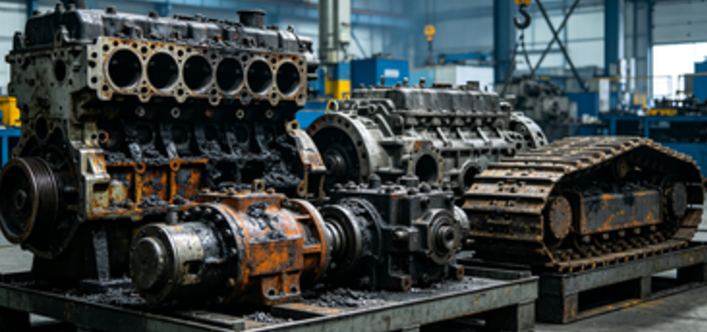
Heavy machinery components — engine blocks, cylinder heads, gearboxes, hydraulic valves, and track assemblies — carry some of the toughest soils in industrial cleaning: burnt-on carbon, heavy grease, oxidized oil, rust scale, and metallic swarf. Traditional methods like hot tank washing, hand scrubbing, and sand blasting are labor-intensive, inconsistent, and often damage precision surfaces. Industrial ultrasonic cleaning has become the preferred method for heavy equipment maintenance, rebuild, and remanufacturing operations worldwide.
Why Traditional Methods Fall Short on Heavy Components
Heavy machinery parts present unique cleaning challenges: – Complex internal geometry — oil galleries, coolant passages, blind holes, and threaded features trap contaminants – Heavy soil loads — years of accumulated grease, carbon, and varnish – Mixed materials — aluminum, cast iron, steel, and bearing surfaces in a single assembly – Large size and weight — parts weighing from 50 kg to several metric tons
Hot spray cabinets and jet washers only clean what the spray pattern hits. Internal passages and shadowed areas remain contaminated. Hand cleaning is slow, inconsistent, and exposes workers to harsh chemicals.
How Ultrasonic Cleaning Handles Heavy Machinery Parts
Ultrasonic systems use high-frequency sound waves to create microscopic cavitation bubbles in a heated detergent bath. These bubbles collapse on all exposed surfaces — including internal passages unreachable by spray — producing a scrubbing action that lifts grease, carbon, and particulate.
Key advantages for heavy equipment components: – 360° internal cleaning — reaches every oil gallery and coolant passage – Consistent results — every part receives identical cleaning, batch after batch – Reduced labor — one operator can load/unload while the cycle runs automatically – Surface-safe — no abrasive media that damages machined surfaces or sealing faces – Faster turnaround — typical cycles of 10–20 minutes vs. hours of manual work
Recommended System Configurations
Single-Stage Heavy-Duty Ultrasonic Tanks
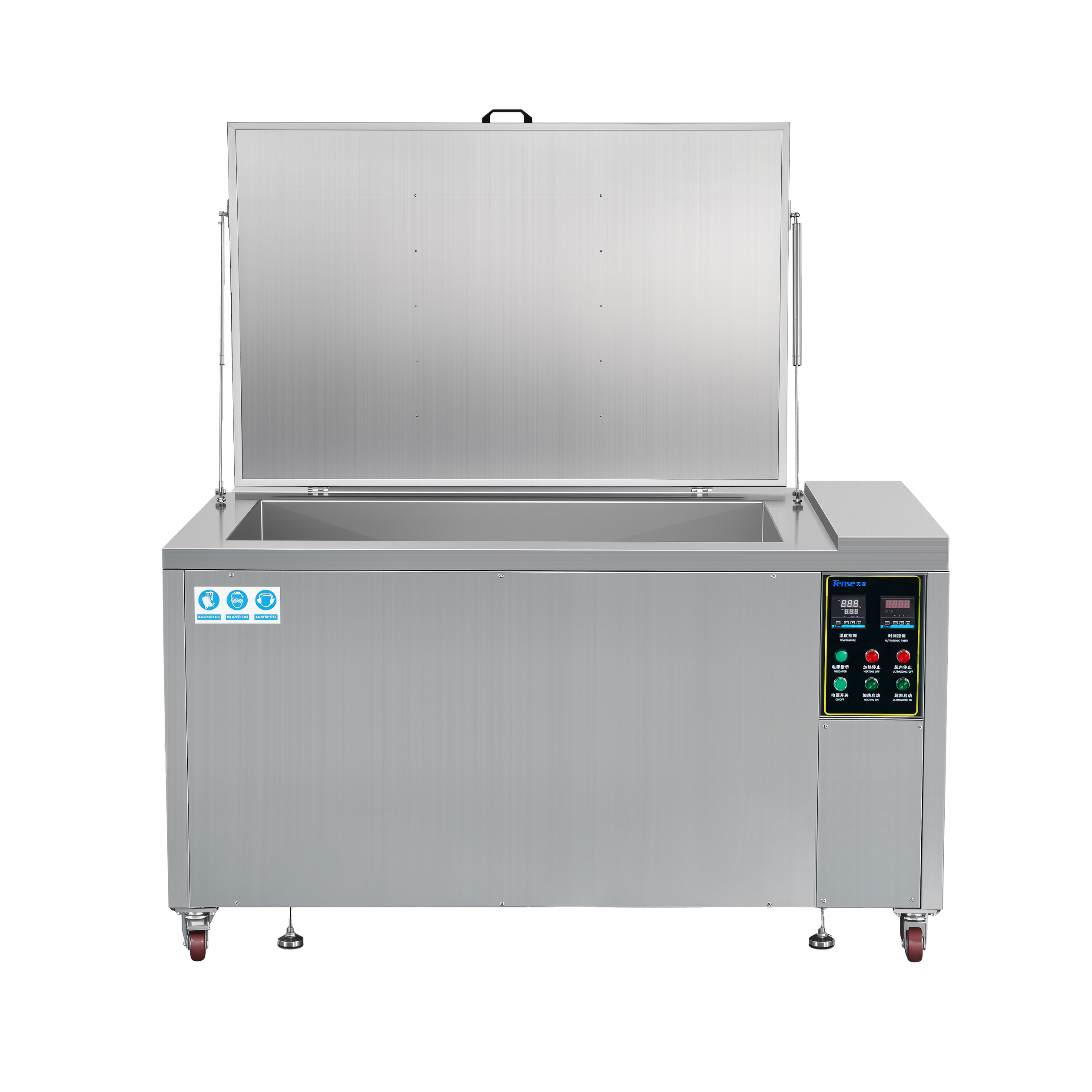 For maintenance shops and smaller rebuild operations, a single large-capacity ultrasonic tank with integrated filtration and oil skimming is often sufficient.
Specifications for heavy machinery use: – Tank sizes from 500L to 5,000L+ custom dimensions – 20–28 kHz low frequency for aggressive heavy-soil removal – Stainless steel 316L construction for extended tank life – Oil skimmer and particulate filtration to extend bath life – Hoist or crane loading for parts up to several tons
Multi-Stage Automated Lines
For high-volume remanufacturing facilities processing dozens of components daily, multi-stage lines deliver maximum throughput: 1. Ultrasonic wash stage — primary degreasing and carbon removal 2. Rinse stage — removes detergent residue and loosened particulate 3. Second ultrasonic or spray rinse — final precision cleaning 4. Hot air blow-off / drying stage — prevents flash rust on ferrous parts 5. Optional rust inhibition dip — for storage before reassembly
Tense designs and builds TS series ultrasonic cleaning machine for engine remanufacturing and heavy equipment service centers worldwide.
|
Model |
TS-3600A |
TS-4800A |
TSD-6000A |
TSD-7000A |
TSD-8000A |
| Dimension (mm) |
1460 x 1240 x 920 |
1680 x 1220 x 970 |
1880×1440×1100 |
2300×1800×1460 |
2600×1950×1600 |
| Volume(ltr) |
308 |
430 |
780 |
1147 |
1600 |
| Tank size (mm) |
1000×550×560 |
1200×600×600 |
1400×800×700 |
1700×900×750 |
2000×1000×800 |
| Useful size (mm) |
920×510×420 |
1170×560×490 |
1260×690×560 |
1530×730×580 |
1860×860×680 |
| Heating (KW) |
10.0 |
10.0 |
22.0 |
22.0 |
30.0 |
| Ultrasonic power(KW) |
1.8 |
3.5 |
5.3 |
12.0 |
16.0 |
| Transducer Qty. (pcs) |
40 |
60 |
96 |
128 |
200 |
Real-World Applications in Heavy Machinery
Engine Blocks & Cylinder Heads
Ultrasonic cleaning removes carbon from combustion chambers, cleans all oil galleries, and flushes coolant passages — critical for proper oil flow and heat transfer in rebuilt engines. Cast iron and aluminum heads are cleaned without damage to valve seats and bearing surfaces.
Hydraulic Components
Servo valves, pump bodies, and manifold blocks require absolute cleanliness to prevent premature failure. Ultrasonic cleaning removes every trace of hydraulic fluid, metallic particles, and sealant residue from internal spool bores and cross-drilled passages.
Gearboxes & Transmission Housings
Gear teeth, bearing bores, and internal webs are thoroughly degreased, preparing parts for inspection and crack testing (magnetic particle or dye penetrant inspection).
Track & Undercarriage Components
For track pins, bushings, and rollers, ultrasonic systems remove packed grease and road grime faster than pressure washing, with less water consumption and wastewater volume.
Process Optimization Tips
1. Pre-rinse heavily soiled parts to remove bulk grease before ultrasonic cleaning — extends bath life significantly
2. Use the right detergent — alkaline water-based cleaners for most heavy machinery applications; avoid corrosive chemistries on aluminum
3. Maintain 55–70°C bath temperature for optimal cavitation and detergent performance
4. Filter continuously — 10–50 micron filtration removes suspended particulate
5. Surface-activate oil skimming — removes floating oil that would otherwise redeposit on parts
Conclusion
For heavy machinery maintenance and remanufacturing, industrial ultrasonic cleaning delivers cleaner results in less time with lower labor cost than traditional methods. Whether you need a single heavy-duty tank for a service shop or a fully automated multi-stage line for a remanufacturing plant, the right system configuration directly improves rebuild quality and reduces turnaround time.
Learn more about custom configurations for heavy equipment at Tense Industrial Cleaning Systems.
Frequently Asked Questions
Q: Can ultrasonic cleaning remove carbon buildup from engine cylinder heads? A: Yes. With proper detergent formulation and 20–28 kHz frequency, ultrasonic cavitation effectively removes baked-on carbon from combustion chambers and valve seats. Cycle times range from 15–30 minutes depending on carbon thickness.
Q: Will ultrasonic cleaning damage aluminum engine components? A: No, when operated at correct parameters. Aluminum parts are safely cleaned at standard frequencies. Avoid excessively high temperatures (>70°C) and highly caustic detergents, which can attack aluminum over extended exposure.
Q: How large can heavy machinery ultrasonic cleaning tanks be? A: Custom tanks can be built to any required size. Tense has manufactured systems exceeding 10,000 liters for large engine blocks, locomotive components, and marine engine parts. Parts weighing several tons can be accommodated with proper tank reinforcement.
Q: Is wastewater from heavy machinery ultrasonic cleaning hazardous? A: The wastewater contains removed oils, grease, and particulate, so it requires treatment before discharge. Integrated oil-water separators and filtration systems reduce waste volume. Tense offers matching wastewater treatment systems for closed-loop operation.
Post time: Jul-15-2026